QQQ vs SPY: What $1,000 Invested 20 Years Ago Is Worth Now
Mega-cap tech and communications stocks deliver outsized rewards — and greater risk.

The past two decades have been dominated by digital innovations. From mobile to social to cloud computing and now AI, technology and communication services companies have become the biggest stocks on the planet.
The Invesco QQQ Trust (QQQ) exchange-traded fund, which comprises the 100 largest nonfinancial stocks on the Nasdaq, has been a great way to play the market's biggest secular growth story of the past 20 years. Just look at this murderers' row of its five biggest holdings: Nvidia (NVDA), Apple (AAPL), Microsoft (MSFT), Micron Technology (MU) and Amazon.com (AMZN), which collectively account for 30% of the ETF.
When it comes to cheap and easy diversification, you can't go wrong with an S&P 500 ETF, such as the Vanguard S&P 500 ETF (VOO) or SPDR S&P 500 ETF (SPY).
From just $107.88 $24.99 for Kiplinger Personal Finance
Become a smarter, better informed investor. Subscribe from just $107.88 $24.99, plus get up to 4 Special Issues

Sign up for Kiplinger’s Free Newsletters
Profit and prosper with the best of expert advice on investing, taxes, retirement, personal finance and more - straight to your e-mail.
Profit and prosper with the best of expert advice - straight to your e-mail.
Technology and communications names account for almost 48% of the S&P 500, but holding five times the number of stocks versus QQQ means the mega-caps have less influence. Apple, Microsoft and Nvidia represent a significantly larger percentage of QQQ's total assets, amplifying its returns as those specific companies have reached multi-trillion-dollar valuations.
The S&P 500 also holds lots of banking and insurance stocks, which, as noted above, QQQ excludes. The great financial crisis and subsequent era of rock-bottom interest rates did the financial sector — and the S&P 500 — few favors. Financial stocks account for almost 12% of the benchmark index today.
The steady ascent of tech and the worst downturn since the 1930s pretty much explain QQQ's extraordinary returns over the past 20 years. To be sure, the S&P 500 has been very good to patient investors, but it lags QQQ by wide margins.
The bottom line on QQQ vs SPY
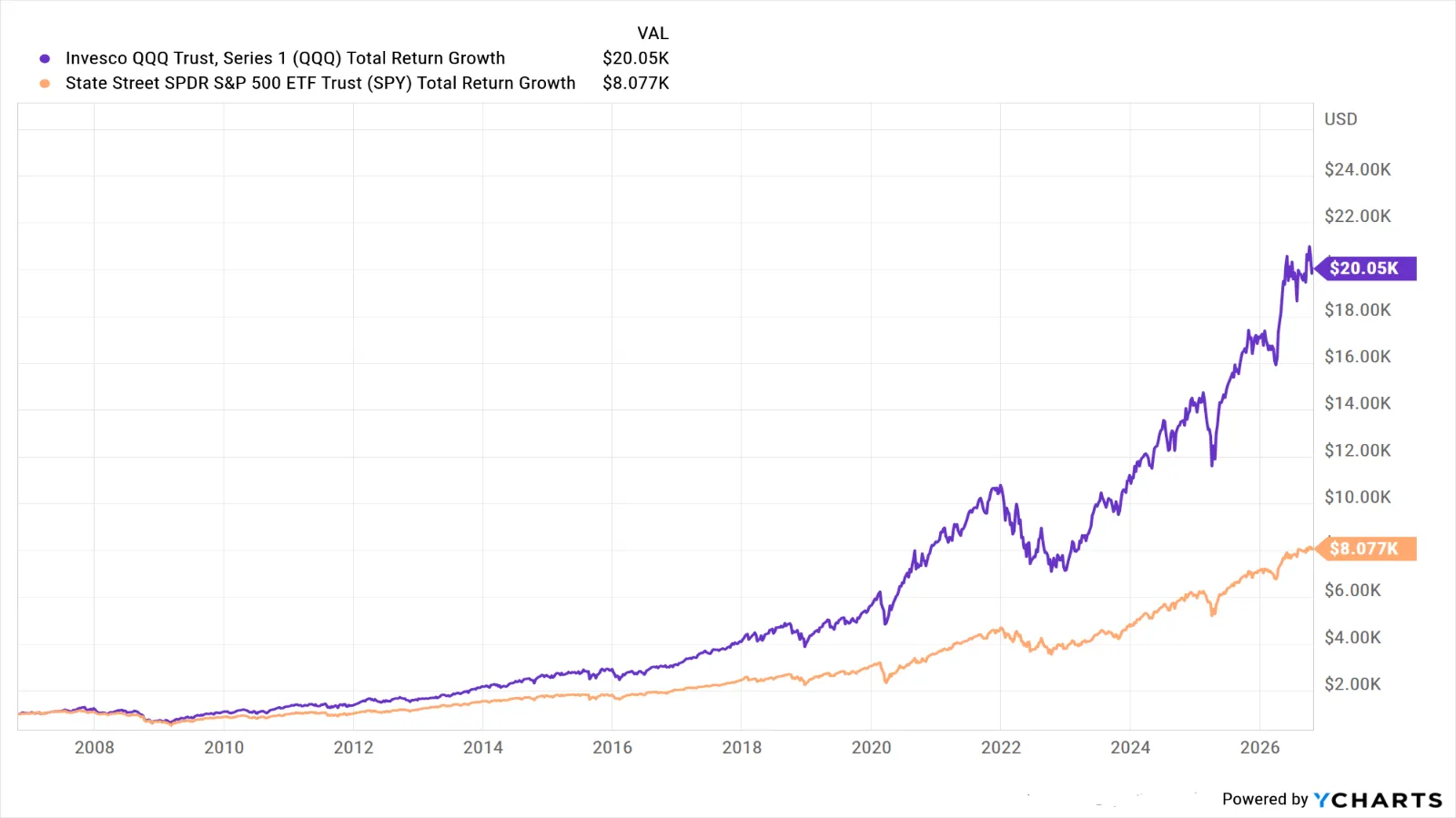
Have a look at the above chart and you'll see that if you invested $1,000 in QQQ 20 years ago, it would today be worth $20,000. That's good for an annualized total return (price change plus reinvested dividends) of 16.1%.
By comparison, the same sum socked away in SPY would be worth $8,000, or 11% annualized. That's pretty darn good and, importantly, it came with much less volatility.
This last point is key. As they say on Wall Street, there is no such thing as a free lunch. True, QQQ greatly outperformed the broader market, but that outperformance is a risk premium. When the Federal Reserve started rapidly raising interest rates in 2021 and 2022, QQQ fell 36% from its peak. SPY suffered a drawdown of roughly 25%.
As gaudy as QQQ's past performance has been, remember that it comes with more risk. And if all things AI really do lead to a burst bubble, this ETF is sure to take an outsized beating.
More Stocks of the Past 20 Years
- If You'd Put $1,000 Into Nvidia Stock 20 Years Ago, Here's What You'd Have Today
- If You'd Put $1,000 Into Apple Stock 20 Years Ago, Here's What You'd Have Today
- If You'd Put $1,000 Into Amazon Stock 20 Years Ago, Here's What You'd Have Today