
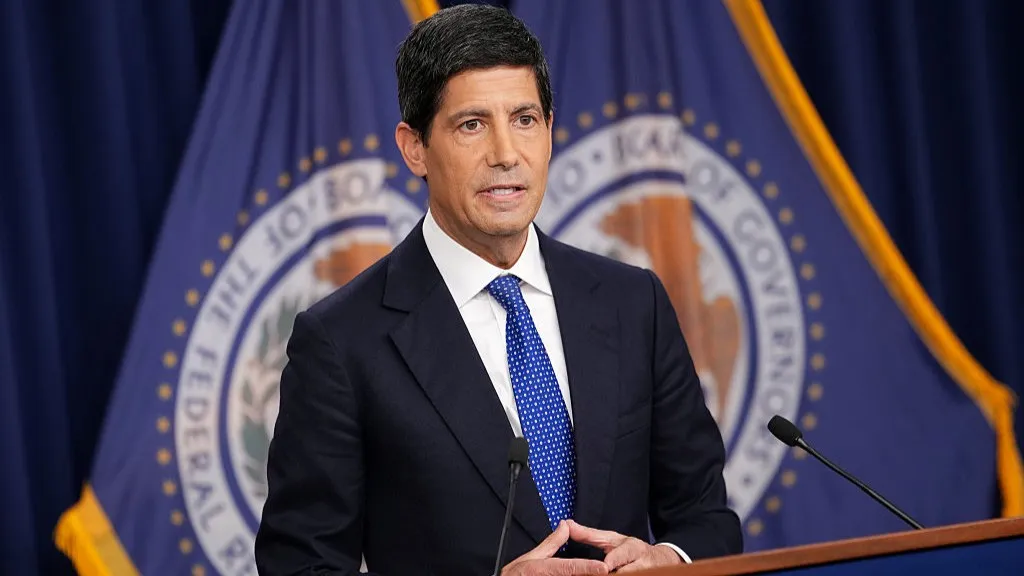
The next Federal Reserve meeting concluded today, October 28, with the latest policy decision.
With the midterms right around the corner, the Fed kept interest rates unchanged, as was widely expected.
And while Fed Chair Kevin Warsh's press conference did not forecast any future policy moves, expectations for a December rate hike are high.
The Kiplinger team reported live on the October Fed meeting, bringing you the news and our expert analysis of what it could mean for the economy. Scroll for the updates.
How Does the Federal Reserve Work? | How the New Fed Chair Could Impact What You Pay in Taxes This Year | Best Stocks to Buy for Rising Interest Rates
Stocks trade higher to start Fed week, Treasury yields churn
Stocks are trading comfortably higher Monday as Wall Street looks ahead to a busy week that includes the Fed meeting and a jam-packed earnings calendar.
At last check, the tech-heavy Nasdaq Composite is leading the pack — up 1% at 26,213 — on enthusiasm over the upcoming Anthropic IPO. The broader S&P 500 is 0.7% higher at 7,679, while the blue-chip Dow Jones Industrial Average has gained 0.2% to 52,300.
The positive price action in stocks comes even as the 2-year Treasury yield trades 2.1 basis points higher at 4.703%. Yields on the 10-year and 30-year Treasuries are slightly lower.
Who gets to vote at the October Fed meeting?
The Federal Open Market Committee (FOMC) has 12 total members, eight permanent and four who rotate each year.
The eight permanent voting committee members include the Fed chair and vice chair, the five Fed governors and the president of the New York Fed.
Four regional Fed presidents are rotated in each calendar year.
The 2026 FOMC voting committee consists of:
- Fed Chair Kevin Warsh
- Vice Chair Philip Jefferson
- Fed Governor Michael Barr
- Fed Governor Michelle Bowman
- Fed Governor Lisa Cook
- Fed Governor Jerome Powell
- Fed Governor Christopher Waller
- New York Fed President John Williams
- Cleveland Fed President Beth Hammack
- Minneapolis Fed President Neel Kashkari
- Dallas Fed President Lorie Logan
- Philadelphia Fed President Anna Paulson
In 2027, the presidents from Chicago, Richmond, Atlanta and San Francisco will rotate in as FOMC voting members, according to the Federal Reserve.
- Karee Venema
With over a decade of experience writing about the stock market, Karee Venema is the senior investing editor at Kiplinger.com. She joined the publication in April 2021, and oversees a wide range of investing coverage, including content focused on equities, fixed income, mutual funds, ETFs, macroeconomics and more.
When is the next Fed meeting for interest rates?
The Federal Open Market Committee will kick off its next policy meeting this Tuesday, October 27, and issue its latest policy statement on interest rates at 2 pm Eastern Standard Time on Wednesday, October 28.
According to CME Group FedWatch, futures traders are currently pricing in a nearly 90% probability that the central bank will keep the federal funds rate at its current range of 3.75% to 4.0% this time around.
Deutsche Bank economists believe there are several reasons the Fed will pause after hiking rates in September. "Financial conditions have started to tighten, though they remain accommodative on many metrics," the group writes. "Officials might want to see how much FCI [Financial Conditions Index] tightening occurs for reasons outside of monetary policy before taking further action. One could also argue that if tightening is needed to catch up to a rising neutral rate, it makes sense to take a gradual approach in this adjustment given that r-star is uncertain."
The economists also feel that "the Fed might prefer to stay out of the headlines for raising rates just ahead of a midterm election where affordability is the principal concern."
- Karee Venema
Fed meeting schedule for 2026 and 2027
The next Fed meeting, which runs October 27 through 28, marks the second-to-last gathering of 2026.
"The committee meets eight times a year, or about once every six weeks," explains Kiplinger contributor Dan Burrows.
The Federal Open Market Committee "is required to meet at least four times a year and may convene additional meetings if necessary," Burrows adds, noting that "the convention of meeting eight times per year dates back to the market stresses of 1981."
Fed meetings last two days and wrap up with the release of a policy decision at 2 pm Eastern Standard Time. This is typically followed by the Fed chair's press conference at 2:30 pm, though this could change under Warsh's leadership.
The final meeting of 2026 will occur on December 8 and 9.
As for 2027, here is the full Fed meeting schedule:
- January 26 to 27
- March 16 to 17
- April 27 to 28
- June 8 to 9
- July 27 to 28
- September 14 to 15
- October 26 to 27
- December 7 to 8
- Karee Venema
The Fed is expected to hike again in December
Odds are low that the Federal Reserve will raise interest rates this week, but CME Group FedWatch shows futures traders are pricing in a 73% chance it will hike again in December, up from 42% one month ago.
Paul Eitelman, global chief investment strategist at Russell Investments, agrees. "We expect a hawkish hold in October with the Fed delivering one more hike at year-end. Growth has been solid, supported by strong earnings, the AI buildout, and resilient consumer spending."
But price pressures have been hot, he notes, with inflation not falling at a quick enough speed to satisfy Chair Warsh. The strategist believes inflation will moderate in 2027 "as wage and shelter inflation remain modest, but "geopolitics, energy prices, the AI buildout, and broader supply chain pressures pose upside risks."
If these risks fade, Eitelman feels "the risk of a sustained tightening cycle should fade, too."
- Karee Venema
Where have all the Fed speakers been?
The Fed-speak has been nonexistent over the past week or so. That's by design. Since Saturday, October 17, and until Thursday, October 29, participants in the FOMC meeting have been bound by a Federal Reserve policy that limits the extent to which they can talk about the economy and interest rates.
These two-week "blackout periods" begin the second Saturday that falls 10 days before the next FOMC meeting and end the Thursday that follows the meeting. The Fed's blackout period was an unofficial practice that began in the 1980s. It was formalized in 2011 and reaffirmed in January 2025.
Fed-watchers see the policy as a measure against corruption and the potential for information leaks to distort markets. It also provides cover for open discussion during the Fed's most intense periods of policy-making.
Here is a schedule (pdf) for all blackout periods through January 2028.
- David Dittman
David Dittman is the former managing editor and chief investment strategist of Utility Forecaster and the former editorial director of Investing Daily, Charles Street Research, and Weiss Ratings. A former stockbroker, David has been working in financial media for more than 20 years.
The Fed can afford to remain patient, says Glenmede's strategy team
Jason Pride, chief of investment strategy & research and Michael Reynolds, vice president of investment strategy at Glenmede, expect the Federal Reserve to remain on hold this week.
"The Fed can afford to remain patient as it weighs persistent price pressures against continued economic resilience," the two say. "Additional economic data into year-end should help determine whether recent price pressures represent a temporary setback or a more durable trend that may warrant a more restrictive policy stance."
Pride and Reynolds are anticipating a December rate hike. This, they say, "is likely to take the fed funds rate into modestly restrictive territory, a level at which strain can build in the parts of the economy most sensitive to credit."
Indeed, while higher long-term bond yields are currently creating a higher cost of capital, "they have not yet resulted in material stress in the U.S. financial system."
Pride and Reynolds add that investors must prepare for monetary policy to remain "modestly restrictive" over the next few quarters. "The prognosis on inflation is likely to be the single largest determinant for the path of fed funds. If price momentum remains stubbornly sticky, particularly in core services, that could make the case for a handful of rate hikes into the middle of 2027."
- Karee Venema
Midterms will keep the Fed on hold this week
"The recent elevated level of inflation would likely have caused the Fed to raise short rates a quarter point this week, but we expect the looming elections to give the Fed pause and raise rates at their December 9 meeting instead," says David Payne, staff economist and reporter for The Kiplinger Letter.
The September Consumer Price Index (CPI) report, released on October 14, showed headline inflation rose 0.6% from August to September and 3.7% year over year. This was faster than the 0.4% monthly and 3.4% annual increases seen in August, with the year-over-year rate coming in above economists' estimate of a 3.6% rise.
"The index for gasoline rose 9.1 percent in September, accounting for over half of the monthly all items increase," according to the BLS. "The energy index increased 5.2 percent over the month following a 2.1-percent increase in August."
Shelter costs were higher, too, while food prices were unchanged.
Core CPI, which excludes volatile food and energy costs, rose 0.3% month over month in September, the same as in August. Year over year, core inflation was up 2.6%, faster than the 2.4% rise from the month prior. Economists expected core CPI to rise 0.2% month over month and 2.5% year over year.
Prices for recreation, used cars and trucks, education, airline fares, medical care and apparel were higher, while communications costs were slightly lower.
- Karee Venema
All eyes will be on Chair Warsh's post-meeting press conference, says Johnson Investment Counsel's chief economist
Brandon Zureick, chief economist and senior managing director at Johnson Investment Counsel, does not expect the Federal Reserve to raise rates this week, even as inflation data suggests additional tightening is warranted.
"While policymakers have continued to signal that additional tightening could be warranted, recent communications have also emphasized patience and a more deliberate approach to policy decisions," Zureick explains.
Once the October Fed meeting wraps up, the economist believes "attention will quickly shift to the December meeting, where another rate increase is likely, should inflation fail to show further improvement."
While the December Fed meeting will include an updated Summary of Economic Projections, including the closely watched "dot plot," the October gathering will not. As such, Zureick says "investors will be particularly focused on Chair Warsh's post-meeting press conference for clues about the future path of monetary policy. Any insight into how policymakers are weighing inflation risks, labor market trends, and the appropriate endpoint for this tightening cycle could prove just as important to markets as the rate decision itself."
- Karee Venema
Stocks close higher to start Fed week
Stocks rebounded Monday on the revival of the artificial intelligence trade, as the developer of the Claude large language model and AI assistant filed for what would be the biggest initial public offering (IPO) in stock market history.
"AI jitters and oil prices have kept stocks off balance," E*TRADE From Morgan Stanley Managing Director Chris Larkin observes, "but this week's lineup of high-profile earnings and economic data may have the potential to push the market out of its trading range — one way or the other."
By the closing bell, the tech-heavy Nasdaq Composite had risen 0.8% to 26,169, the broad-based S&P 500 was up 0.7% at 7,676, and the blue-chip Dow Jones Industrial Average had added 0.3% to 52,361.
Read more: Stocks Start a Big Week With Solid Gains: Stock Market Today
Stocks set to open higher on day one of October Fed meeting
Equity index futures indicated a positive open for the stock market on the first day of the October Fed meeting, with markets poised for earnings reports from three of the Magnificent 7 stocks this week, too.
CME FedWatch shows a 90.6% probability the Federal Open Market Committee (FOMC) holds the federal funds rate steady at a target range of 3.75% to 4.00%.
That's where the benchmark sits after a 25-basis-point increase following the September Fed meeting, the central bank's first rate hike in three years.
The yield on the 2-year Treasury is up 2.4 basis points to 4.735% shortly before the opening bell at the New York Stock Exchange, and the 10-year (+0.9 bps, 4.995%) and the 30-year (+0.1 bps, 5.302%) are up as well.
The front-month West Texas Intermediate crude oil futures contract was down 0.9% to $100.89 per barrel amid renewed hope for a diplomatic solution to the war between the U.S. and Iran.
– David Dittman
Why the October Fed meeting is about the December Fed meeting
There's no law, not even a rule, that says the Federal Reserve can't raise (or lower) interest rates right before an election.
It's tradition not to make changes to the federal funds rate as voters are heading to the polls. And that tradition has been violated, maybe not often, but as recently as the last midterm elections.
Indeed, the Federal Open Market Committee ((FOMC) announced a 75-basis-point rate hike on November 2, 2022, six days ahead of the climax of a midterm campaign that was all about inflation.
The Consumer Price Index (CPI) had printed at a 40-year peak of 9.1% on an annual basis that June. It was the biggest year-over-year increase since November 1981.
Note, too, that the Ben Bernanke-led Fed cut interest rates by 50 basis points on October 29, 2008, while a presidential election was winding up to its November 4 conclusion.
That big move was made in response to the escalating global financial crisis, with broad support as monetary and fiscal policymakers adopted unusual measures to stave off another depression.
Inflation is nowhere near 9.1%. And there's no sign of imminent financial/economic collapse. So Kevin Warsh & Co. will probably observe tradition.
At the same time, threats to price stability aren't easing, and FedWatch sees a 75.1% probability of a 25-basis-point rate hike following the December Fed meeting.
So markets will pay close attention to Warsh's press conference for hints about where he and the committee stand as far as the trajectory of incoming inflation and employment data over the next six weeks.
– David Dittman
Inflation expectations decline in October
The Conference Board Consumer Confidence Index was up 7.5 points to 91.7 in October, helped by a better outlook on price stability.
According to Conference Board survey results, average 12-month inflation expectations among consumers declined "but remained elevated at 5.8%."
As Fed Chair Kevin Warsh said in his keynote address at the Jackson Hole Economic Symposium in August, "It's the Fed's job to make sure that inflation expectations do not get unanchored."
Consumers also expect higher interest rates over the next 12 months. At the same time, more consumers expect stock prices to increase over the next 12 months.
– David Dittman
What the 9.4% see
At lunch hour on the first day of the October Fed meeting, CME FedWatch shows a 90.6% probability the central bank holds the target range for the federal funds rate steady at 3.75% to 4.00%.
Based on 30-day fed funds futures prices, 9.4% of market participants still see a 25-basis-point rate hike on the horizon.
Why?
“If you just used risk management and you looked at the data, they want to be hiking this week,” former Fed economist and current New Century Advisors Chief Economist Claudia Sahm told Nick Timiraos.
Sahm, a former Fed economist, sees no reason to wait six weeks with incoming inflation data already accelerating.
Barclays Chief U.S. Economist Marc Giannoni spilled it to Timiraos, too, saying the aim right now, with midterm elections happening next Tuesday, is “staying out of the news.”
Giannoni, like Sahm, is a former Fed economist. "We expect no surprises," he wrote last week in a preview of this week's meeting, forecasting "a hold in October, followed by two successive hikes."
Indeed, the economist says his call "mainly reflects prior signaling and election-timing considerations." His call for hikes in December and January is based on "CPI-driven upward revision to our inflation forecasts."
– David Dittman
Where the money is flowing right now
It's a twitchy market, but that's where the value is. And, right now, 30-day fed funds futures pricing is moving in the direction of a rate hike at the conclusion of the October Fed meeting.
According to CME FedWatch, the probability the Fed holds is down to 88.4% from 90.6% earlier on Tuesday. It was 84.5% a week ago, and 35.8% a month ago.
West Texas Intermediate (-1.7%, $99.99 per barrel) and Brent (-1.2%, $109.46) crude oil futures were down more than 1%, though both contracts have posted solid gains this month.
Meanwhile, the 2-year (+2.2 basis points, 4.733%), the 10-year (+0.7 bps, 4.993%) and the 30-year (+0.3 bps, 5.304%) Treasury yields are all higher for the day.
All three main equity indexes are in positive territory, with the tech-heavy Nasdaq Composite leading the way higher with a gain of more than 1%.
The Dow Jones Industrial Average is holding above the breakeven line, while the broad-based S&P 500 is well in the green.
– David Dittman
Fed heads and crack spreads
Crude oil is still a critical input for the global economy, a lesson we're relearning in real time with another war in the Middle East making an almost literal choke point of the Strait of Hormuz.
On Friday, February 27, the last trading day before the conflict between the U.S. and Iran turned hot again, the front-month West Texas Intermediate crude oil futures contract closed at $67.02 per barrel.
Today, it's tracking back about 1% and is below $100 again. WTI is still up about 50% since the war began. And that's a big deal. But WTI (and the global benchmark, Brent) only tells us about the price of the input.
We – and staff economists at the Federal Reserve – need things like the crack spread, a benchmark for the refining industry, to tell us about the prices we're really paying at the pump, for example.
It's a key variable that regional banks such as the Dallas Fed follow as a forward-looking indicator for costs, inflation and broader economic activity.
The 5:3:2 crack output ratio, for example, means that for every five barrels of crude, the refinery makes three barrels of gasoline and two barrels of distillate.
"Higher spreads signal refiners to increase output and can incentivize firms to shift the crack ratio from one product to another," the Dallas Fed explains, "though the technical capacity to do that is limited."
As BCA Research Chief Commodity Strategist Roukaya Ibrahim observes, "Refined product markets have been at the epicenter of the oil disruption for most of the Iran war."
Indeed, the crack spread has widened meaningfully this year. Lately, though, crude oil prices have been rising, while gas and distillate prices have been falling.
So should we expect crack spreads to keep narrowing from here? Sadly, no, says the commodity strategist.
Ibrahim cites escalating tanker attacks and Houthi strikes on Saudi infrastructure, as well as depleted inventories, as catalysts for a near-term spike for crude oil.
On top of that, rising Chinese product exports that have cushioned refined fuel prices and supported narrowing crack spreads are unlikely to continue at current levels.
At the same time, deferred US refinery maintenance raises the risk of future output curtailments that would tighten product markets and widen cracks.
"We suspect that this trend is nearing its end," Ibrahim concludes. "Crude oil price risks remain skewed to the upside in the near term, and product prices are unlikely to stay insulated as the boost from Chinese exports has likely reached its limit."
– David Dittman
How many dissents from a Fed decision to hold?
Blogger, Economist and Fed-watcher Ethan Harris has discerned "a pattern of hikes at every other meeting," citing recent commentary from voting members of the Federal Open Market Committee (FOMC) suggesting a hold will happen this week.
That's not necessarily a good thing: "The Fed is behind the curve in its inflation fight and will only slowly catch up," Harris writes. He also says we should look beyond Fed Chair Kevin Warsh and listen to what other FOMC members say.
"When it comes to guidance on the December meeting," Harris says, "rather than search for subtle messages from the Chair, concentrate on the clear message from the rest of the committee." He notes that most of the FOMC had spoken before the "blackout period" around the current meeting.
Indeed, New York Fed President John Williams and Vice Chair Philip Jefferson are feeling "so strongly about staying on hold, they signaled their view before even seeing the inflation data for September."
According to Harris's accounting, four voting members have signaled they'll vote for a hold, two have signaled they'll vote for a hike and six haven't signaled anything.
"This sets us up for a replay of the July meeting," Harris concludes, "with the majority voting for no change in policy and several dissents in favor of an immediate hike."
Harris led the Domestic Research Division at the NY Fed in the late 20th century. He was chief U.S. economist at Lehman Brothers from 1996 to 2008 and head of global economics at Bank of America (BAC) from 2009 to 2023. He's now working under his own banner at Ethan on the Economy.
– David Dittman
Update: Fed funds futures flow
Heading into the closing bell, CME FedWatch shows a 92.8% probability the Federal Open Market Committee (FOMC) announces a hold at the conclusion of its meeting tomorrow afternoon.
That's up from 88.9% at the closing bell on Monday. The probability of a hold ticked up to 90.6%, then down to 88.4% intraday before bouncing again. It was 84.5% a week ago, and 35.8% a month ago.
The Fed is unlikely to announce a "surprise" rate hike. As Ethan Harris explains, voting members of the FOMC would have prepared markets and the public by making their cases ahead of the meeting.
"Clearly that preparation hasn’t happened," the economist and Fed-watcher writes. "According to CMS FedWatch, markets see about a 10% chance of a hike this week. Showing independence is good; sandbagging the markets and the public is not."
– David Dittman
Stocks rise on the first day of the October Fed meeting
Stocks closed higher Tuesday as market participants panned a busy batch of corporate earnings reports and looked ahead to tomorrow's Federal Reserve policy announcement.
Chip stocks were a notable pocket of strength, with several mega caps soaring on news of a $63 billion deal between Broadcom (AVGO) and Anthropic (ANT).
At the close, the tech-heavy Nasdaq Composite was up 1.2% at 26,477, the broader S&P 500 was 0.6% higher at 7,722, and the blue-chip Dow Jones Industrial Average had added 0.03% to 52,377.
Read more: Nasdaq Jumps 308 Points on Broadcom's Big Gains: Stock Market Today
Stock futures signal a mostly higher open on Fed Day
Stock futures are signaling a mostly higher open on Wednesday, with all eyes on this afternoon's policy statement from the Federal Reserve.
Futures on the Nasdaq-100 are up 0.4% at last check, as strong earnings from South Korean chipmaker SK Hynix (SKHY) lift sentiment. Futures on the S&P 500 are 0.2% higher, while the Dow Jones Industrial Average is slightly lower ahead of the open.
How well do you know the Fed?
Fed meetings have become key events as central bank officials try to balance high inflation and a resilient labor market against the White House's desire for lower interest rates.
But how well do you know the Fed?
With the next Fed announcement on deck, we decided to test your basic knowledge of the Federal Reserve with a quick quiz.
Master Your Fed Knowledge: Take Our Quick Federal Reserve Quiz
Big Tech earnings on deck
In addition to Wednesday afternoon's Federal Reserve decision, Wall Street will be watching this week's Big Tech earnings. Alphabet (GOOGL) and Microsoft (MSFT) kick things off after today's close, while Amazon (AMZN) reports tomorrow.
"Investors are laser-focused on AI capex spending, as this spending has been going on for some time, and there will likely be a point when the hyperscalers need to rely more on debt rather than cash flows to finance this spending, but it still seems like we are far from that point, which is welcome news," says Glen Smith, chief investment officer at GDS Wealth Management.
Will Rhind, founder and CEO of GraniteShares, says Alphabet is "the AI winner hiding in plain sight." He points to Google Cloud revenue, which "grew 82% last quarter." Search, meanwhile, "grew 17% with AI built into it, and there's more than half a trillion dollars in Cloud backlog. Anthropic alone has committed to spend at least $114.5 billion with Google through 2033. That’s not a company losing the AI race. That's a company cashing in on it."
As for Amazon, Rhind says that the acceleration seen in Amazon Web Services (AWS) changes everything for the mega cap. "Cloud growth just hit its fastest pace in four and a half years, and Anthropic has locked in at least $110 billion of compute with Amazon through 2036. Investors fixated on spending are missing what that spending is buying: demand," he explains.
Read more: Earnings Calendar and Analysis for This Week
- Karee Venema
Mission Wealth's CIO expects fewer rate hikes than the market is anticipating
Kieran Osborne, CIO at Mission Wealth, does not anticipate a rate hike this afternoon, but he does expect the Federal Reserve to lift the federal funds rate in December. This is in-line with what the central bank forecast in its September dot plot.
"At today's FOMC announcement, we’ll be looking for any indications that the Fed may veer from this path for interest rate policy," Osborne adds. "We don't anticipate that's the case, and would have to see material changes in economic data to warrant an adjustment in our outlook for interest rates heading into year-end."
That said, Osborne thinks the market is pricing in more Fed rate increases than is warranted, which has caused Treasury yields to spike. "We anticipate one or two more rate hikes before a pause, whereas the market had been pricing in around four total hikes. Should the market's assessment continue to moderate, we would expect downward pressure on interest rates."
- Karee Venema
What time will the Fed statement be released and what changes are expected?
The Federal Open Market Committee will release its updated policy statement at 2 pm Eastern Standard Time today, October 28.
"Economic activity is expanding at a solid pace, the FOMC stated in its September statement. "While uncertainty remains elevated owing, in part, to geopolitical developments, domestic spending has been resilient. Productivity growth is strong, and capital investment is robust. Job gains have kept pace with the workforce, and the unemployment rate has changed little."
However, the committee noted that "inflation remains elevated," and unanimously voted to raise interest rates by a quarter-percentage point to "support a timelier return to the Committee's 2 percent goal."
Deutsche Bank economists expect "minimal changes" to the October FOMC statement. "Other than the policy action language reflecting the hold decision, the only other revision we envision is the removal of the second-to-last sentence explaining the rationale behind last month’s hike: 'Today's policy action will support a timelier return to the Committee's 2 percent goal.'"
- Karee Venema
Stocks are mixed, Treasury yields rise ahead of Fed decision
The main equity benchmarks are trading mixed at midday as market participants keep a cautious eye on this afternoon's Fed decision. The Nasdaq Composite was last seen down 0.07% at 26,459, erasing an earlier lead from strong earnings for South Korean semiconductor manufacturer SK Hynix (SKHY).
The broader S&P 500, meanwhile, is up 0.2% at 7,736 and the blue-chip Dow Jones Industrial Average is 0.2% higher at 52,503.
Over in the bond market, the 2-year Treasury yield was last seen 3.5 basis points higher at 4.772%, while yields on the 10-year (+3.5 bps, 5.028%) and 30-year (+2.4 bps, 5.329%) Treasuries are also up.
What time does Fed Chair Kevin Warsh speak today?
Fed Chair Kevin Warsh will host a press conference at 2:30 pm Eastern Standard Time today, October 28.
"Chair Warsh's press conference will be focused on several topics: Why the Committee decided to not raise rates? How has recent inflation data impacted the monetary policy outlook? What is the Committee's assessment of financial conditions after recent AI-related wobbles?," write Deutsche Bank economists.
The group believes Warsh will indicate that additional tightening is needed to tame inflation, but pausing in October gives the central bank more time to assess the data.
- Karee Venema
The Fed decision is in
The Federal Open Market Committee (FOMC) this afternoon voted to keep the federal funds rate at its current range of 3.75% to 4.00%.
"Economic activity is expanding at a strong pace," the FOMC wrote in its statement. "While uncertainty remains elevated owing, in part, to geopolitical developments, domestic spending has been resilient. Productivity growth is strong, and capital investment is robust. Job gains have kept pace with the workforce, and the unemployment rate has changed little."
By pausing this time around, the Fed is allowing for "the accumulation of more information" to "help the Committee determine the policy stance appropriate to ensure a timely return of inflation to the Committee's 2 percent goal."
Fed Governor Lisa Cook and Cleveland Fed President Beth Hammack dissented in favor of a quarter-percentage-point rate hike.
- Karee Venema
Where can I watch Fed Chair Warsh's press conference?
Fed Chair Kevin Warsh's press conference will begin at 2:30 pm Eastern Standard Time this afternoon.
The presser can be viewed on the Federal Reserve's website or on the Fed's YouTube channel.
What Wall Street is saying about the Fed rate decision
"The Fed is taking a wait-and-see approach, and I think that makes sense given where we are in the cycle. Inflation remains above target, but the labor market has been cooling without showing the kind of widespread deterioration we'd typically associate with a recession. The economy is slowing, but slowing and breaking are two different things. Holding rates steady gives policymakers more time to assess how the economy is responding to September's hike and the recent rise in longer-term borrowing costs." - Andrew Davis, Head of Investment Strategy at Bryn Mawr Trust and a former BLS analyst
"The Fed maintained the status quo by holding rates at the October meeting, allowing itself more time to digest incoming data and the inflationary impact of persistently high energy prices. While recent inflation prints have met expectations, inflation expectations have increased, likely forcing the Fed to match its September forecast and hike again at the December meeting. The economy and jobs market both appear on good footing, which will allow the Fed more room to hike with the goal of minimizing pass-through inflationary impulses." - Ryan Weldon, Investment Director, Portfolio Manager at IFM Investors
"We expect the Fed to resume rate hikes in December. September's strong CPI print is a reminder that upside inflation risks remain, and the Fed is likely to look to take out further insurance. While the September dot plot suggests just one more hike, another increase in energy prices or further strong data prints could bring additional tightening into play next year." - Kay Haigh, Global Head and CIO of Fixed Income and Liquidity Solutions at Goldman Sachs Asset Management
"The Federal Reserve knows that the tools in its toolbox can't control energy prices, which are such a big driver of inflation, so it would rather hike rates carefully and slowly, instead of embarking on a swift hiking cycle. The stock market is moments away from entering its seasonally strong year-end period. We would expect more seasonal strength this year thanks to fading uncertainty from the midterm elections and fading uncertainty from the Federal Reserve because it's likely that they will hike again in December, allowing stocks to move on to other components of the wall of worry. If there was ever a time to stay invested, this is that time, in our view." - Rick Gardner, Chief Investment Officer at RGA Investments
- Karee Venema
The labor market is strong, but inflation remains above target
"Conditions are quite positive" in the labor market, Fed Chairman Kevin Warsh noted in his opening statement. Yet inflation remains above the Fed's target.
While the Fed did not raise interest rates at today's meeting, he noted that conditions in the financial markets are showing some signs of tightening, which should help curb inflation over time. He specifically cited rising energy prices as posing a risk of higher prices in general.
It sounds like the Fed remains concerned about inflation, but was not ready to follow up September's quarter-point interest rate increase with another one today. That seems to point to the December meeting as ripe for a rate hike.
- Jim Patterson
Jim Patterson is the managing editor of The Kiplinger Letter and The Kiplinger Tax Letter. He joined The Kiplinger Letter in December 2010, covering energy and commodities markets, autos, environment and sports business, and previously covered federal grant funding and congressional appropriations for Thompson Publishing Group.
The FOMC to change its meeting structure in 2027
Early in his press conference on Wednesday, Fed Chair Warsh announced a change to the Federal Open Market Committee's meeting schedule, beginning in 2027.
While the Fed will continue to hold eight meetings a year, one of the meetings in 2027 will be dedicated exclusively to "broad monetary policy strategy," Warsh explains. This meeting will not include a vote on the federal funds rate or a policy statement. The chair said he expects two of these such meetings in 2028.
The reasoning behind the change? "To me, it's quite straightforward," explains Warsh, saying it will allow the Fed to have richer conversations and strategic deliberations about monetary policy.
- Karee Venema
Controlling inflation is a gradual process, says Warsh
Asked why, if inflation is too high and the economy is growing robustly, the Fed did not raise rates today, Warsh emphasized that he sees controlling inflation as a gradual process.
He pointed to the message he delivered when he first took over as Fed chair, in which the central bank reiterated its 2% inflation goal and said explicitly that it won't secretly tolerate a higher level than that.
The Fed followed up with a rate increase in September, and he cited data showing that inflation expectations are moving lower. This "monetary medicine is starting to work some," Warsh added, while he acknowledged that the Fed has not achieved its inflation goal yet.
This week's meeting ended up being a time to pause on rate hikes and take stock of where the economy is right now before raising rates further, as part of a long-term process, he said.
- Jim Patterson
Warsh refuses to answer a question on Trump's comments
Fed Chair Warsh demurred when asked by James Rosen of Newsmax if he had anything to say about President Donald Trump's criticism that most of the Federal Open Market Committee was made up of appointees from the Obama and Biden administrations who "would like to see the country do badly, in my opinion."
"I'm not going to be responding to quotes from public officials," asnwered Warsh.
- Karee Venema
Consumer concerns over prices are short-term in nature, says Warsh
Asked if he is concerned that consumers might not trust the Fed's pledges to bring inflation down to 2% because it did not raise interest rates today, Warsh reiterated that 2% goal.
He acknowledged that consumers have reason to worry that prices will rise faster than 2%, particularly at a time when gasoline prices are up sharply, but added that he thinks those concerns are short-term in nature, as opposed to a general loss of confidence that inflation will eventually come down.
- Jim Patterson
Will higher interest rates slow the AI boom?
On the topic of the massive artificial intelligence investment boom, and whether higher interest rates can slow that spending down, Warsh indicated that he believes that higher rates do have an impact. "I don't believe they are somehow divorced from the rest of the economy."
That matters, because the Fed's primary way to slow inflation is to slow economic activity by raising interest rates. If AI spending proceeds full-steam ahead because tech companies believe the return on their investment will be so big that it is worth paying higher rates, then the Fed would have limited ability to press the brakes on the economy as it tries to slow price increases.
It sounds like Warsh sees evidence that the companies building AI data centers and the lenders that are financing that work are in fact sensitive to the cost of credit. If he's right, that raises questions about how durable the AI boom will be as the Fed potentially raises rates further.
- Jim Patterson
Warsh & Co. are attempting to balance the Fed's opposing objectives
The committee's view is that the economy is strong, but they don't think it's too hot. There's been an improvement in productivity for the past couple of years, so the economy has had room to grow a little more.
Chair Warsh still doesn't think he needs to slow the economy and throw people out of work to bring down inflation. That's a good way to balance the Fed's two opposing objectives.
- David Payne
David Payne is both staff economist and reporter for The Kiplinger Letter, overseeing Kiplinger forecasts for the U.S. and world economies. Previously, he was senior principal economist in the Center for Forecasting and Modeling at IHS/Global Insight, and an economist in the Chief Economist's Office of the U.S. Department of Commerce.
Time will tell if the Fed can achieve a happy medium
Warsh noted that the economy is growing at a good clip and appears to be gaining momentum, but he does not believe that automatically means an increase in inflationary pressure.
He sounded a note of optimism that productivity gains can enable the economy to grow faster, for longer, without stoking additional inflation. He said he is not looking to "throw people out of work" by raising interest rates enough that they cause a sharp slowdown in the economy and a rise in the jobless rate.
Of course, an economy that grows well without requiring the Fed to raise rates painfully is the happy medium that every Fed chair wishes for. Time will tell whether Warsh gets his wish.
- Jim Patterson
Smart places to store your cash while inflation remains stubborn
With high inflation persisting and the Federal Reserve keeping rates unchanged, investors and savers must navigate a unique transition. In this environment, where the economy is slowing down but not showing any indications of breaking, it pays to be selective rather than chasing risk, according to Andrew Davis, head of investment strategy at Bryn Mawr Trust and a former BLS analyst.
With this in mind, if you're looking for smart places to park your cash without sacrificing growth or liquidity, strategic balance is key. Whether you're choosing between high-yield savings accounts, building a CD ladder or looking to allocate cash into low-cost index funds, tailoring your approach to your cash flow is essential.
- Sean Jackson

Sean Jackson is a veteran personal finance writer with over 10 years of experience. He's written savings, insurance and debt management eBooks for nonprofits; he's created helpful insurance, travel and homeowner advice for Bankrate, and helped readers save money on energy costs and credit cards with CNET.
Johnson Investment Counsel's chief economist explains what the Fed's meeting change means for investors
The Federal Open Market Committee's decision to keep rates unchanged today was not a surprise, says Brandon Zureick, chief economist and senior managing director at Johnson Investment Counsel, though there were two dissenting votes.
"The Fed justified its decision to pause by noting that 'the accumulation of more information' would help policymakers determine the appropriate stance of monetary policy," he explains, adding that futures traders are currently pricing in an 85% probability for a December rate hike.
Zureick notes that the Fed's upgraded assessment that the economy is expanding at a "strong" pace rather than a "solid" one "reinforces the idea that the economy continues to weather higher interest rates relatively well, even as inflation remains above the Fed's 2% target."
And while Chair Warsh's press conference maintained his "preference for less forward guidance," we did "learn that the FOMC plans to adjust its meeting schedule in the coming years," notes Zureick, with "one of its eight meetings in 2027 is expected to focus exclusively on broader monetary policy strategy, with no interest-rate decision or policy statement. For investors, that could make the remaining policy meetings more consequential and potentially place even greater emphasis on the economic data released between meetings."
- Karee Venema
Stocks close higher after Fed rate decision
Stocks closed higher after the FOMC announced a widely anticipated decision to hold its benchmark interest rate steady on Wednesday, even as markets priced in rising probability of more war in the Middle East.
The main equity indexes were comforted by Fed Chair Kevin Warsh's explanation for the pause, as well as a new change to FOMC meetings moving forward, but still weakened late in the session.
At the close, the broad-based S&P 500 was up 0.3% at 7,743, the blue-chip Dow Jones Industrial Average had added 0.2% to 52,475, and the tech-heavy Nasdaq Composite was higher by 0.3% at 26,549.
Market-based interest rates were mixed, with the 2-year Treasury yield tracking back 3.1 basis points to 4.706%, but the 10-year (+3.3 bps, 5.024%) and 30-year (+4.6 bps, 5.351%) ticking higher for the day.
Read more: Stocks Rise Despite Inflation and War Talk: Stock Market Today