The Best Precious Metals ETFs to Buy for Portfolio Protection
Precious metals ETFs provide a hedge against monetary debasement and exposure to industrial-related tailwinds from emerging markets.


Bitcoin proponents often describe the cryptocurrency as "digital gold" and a hedge against currency debasement. In practice, its recent behavior has looked very different, more like a speculative risk asset.
Bitcoin finished 2025 down more than 6% and fell further early in 2026. Although the world's No. 1 cryptocurrency has rebounded as concerns around fiat currency debasement have intensified, it still looks more like a risk asset than a store of value.
The so-called "debasement trade" refers to the gradual loss of purchasing power in fiat currencies as governments rely on monetary expansion, rising debt and fiscal intervention. This trend can be seen over both long and short time horizons.
From just $107.88 $24.99 for Kiplinger Personal Finance
Become a smarter, better informed investor. Subscribe from just $107.88 $24.99, plus get up to 4 Special Issues

Sign up for Kiplinger’s Free Newsletters
Profit and prosper with the best of expert advice on investing, taxes, retirement, personal finance and more - straight to your e-mail.
Profit and prosper with the best of expert advice - straight to your e-mail.
Over the long term, Bloomberg Intelligence data show that the U.S. dollar accounted for roughly 65% of global foreign exchange reserves in 2001, a reflection of American soft power and trust in its institutions. By 2026, that share had fallen to about 40%, a 25-percentage-point decline over 25 years, or roughly 1% per year.
Short-term pressure has also been visible. The U.S. Dollar Index (DXY) is down more than 10% since January 2025, driven by erratic trade policy, including on-and-off tariffs threatened and levied against longstanding partners such as Canada and the European Union, as well a war in the Middle East that's driven up crude oil and gasoline prices.
These developments have led some commentators to frame the debasement narrative more bluntly as a "sell America" trade, one that affects not just equities but confidence in the currency itself.
Against that backdrop, the strength in precious metals is easier to understand. Gold, silver, platinum and palladium have not necessarily become more productive or intrinsically valuable assets.
Rather, the currency they're priced in has weakened. Each ounce today can be exchanged for more dollars than it could previously, reflecting depreciation in fiat purchasing power rather than a sudden change in the metals themselves.

Investor demand reflects this shift. Physical bullion has been moving quickly off dealer shelves, particularly in markets such as China, where cultural affinity and macro concerns intersect.
At the same time, inflows into precious metals exchange-traded funds (ETFs) have accelerated. These investment vehicles trade throughout the day such as stocks, are highly liquid, charge relatively low fees and closely track the price of the underlying metal.
Here's what investors should know before buying a precious metals ETF, along with our top picks for portfolio protection.
How does a precious metals ETF work?
Precious metals ETFs don't operate like most traditional ETFs or bond ETFs. Instead of being organized as open-ended investment companies under the Investment Company Act of 1940, most precious metals ETFs are structured as grantor trusts governed by the Securities Act of 1933.
When you buy shares of a precious metals ETF, you're purchasing a "fractional, undivided beneficial interest in the assets of the trust." In plain terms, that means you indirectly own a slice of the physical metal held by the trust, rather than just shares in a fund that owns operating businesses or securities.
When new ETF shares are created, authorized participants deliver cash or metal, and the trust acquires physical gold, silver, platinum or palladium on the back end. That metal is stored in secure vaults, typically audited regularly by independent third parties.
This mechanism is what separates precious metals ETFs from most other commodity ETFs. Funds tied to energy or agricultural commodities usually don't physically hold barrels of oil or bushels of wheat. Doing so would be impractical and expensive.

Instead, those ETFs rely on futures contracts, which can introduce tracking differences relative to the spot price. Because precious metals ETFs hold the physical asset, their net asset value (NAV) generally tracks the spot price of the metal closely during market hours, minus expenses.
One important distinction to understand is taxation. In the U.S., gains from precious metals ETFs held in taxable accounts are generally treated as gains on collectibles rather than standard securities.
That means long-term capital gains can be taxed at higher rates than stocks or bond ETFs, which is why many investors prefer to hold precious metals ETFs in tax-advantaged accounts such as Roth IRAs.
How we picked the best precious metals ETFs
The reasons investors turn to precious metals vary widely. For some, the motivation is the debasement trade and the broader "sell America" narrative. For others, it's rising industrial demand, particularly from emerging markets.
Some investors use precious metals to reduce exposure to equity-market risk or credit risk in bonds, while others simply want diversification, given the historically low correlation certain metals have had with traditional asset classes.
Because of this range of use cases, we didn't build this list around a single investor profile, such as long-term holders or short-term traders. Instead, we focused on ETFs that are versatile, well-capitalized and highly liquid.
These funds are designed to work across multiple investment theses, serving as flexible tools rather than narrowly tailored products.
We did exclude several categories of precious metals ETFs based on structure. Most notably, we excluded futures-based funds.
While it's possible to gain exposure to metals through gold or silver futures, these ETFs often actively roll contracts or pursue secondary objectives such as leverage, inverse exposure, hedging strategies or income generation.
These approaches introduce higher fees, more complex tax treatment and tracking differences relative to spot prices, all of which go beyond the straightforward goal of owning the metal itself.
We also excluded closed-end funds (CEFs). Unlike ETFs, CEFs issue a fixed number of shares and don't create or redeem shares on an ongoing basis. As a result, their market prices can deviate significantly from NAV, trading at premiums or discounts depending on investor demand.
Precious metals ETFs avoid this issue through the creation and redemption mechanism, which helps keep prices closely aligned with the value of the underlying metal.
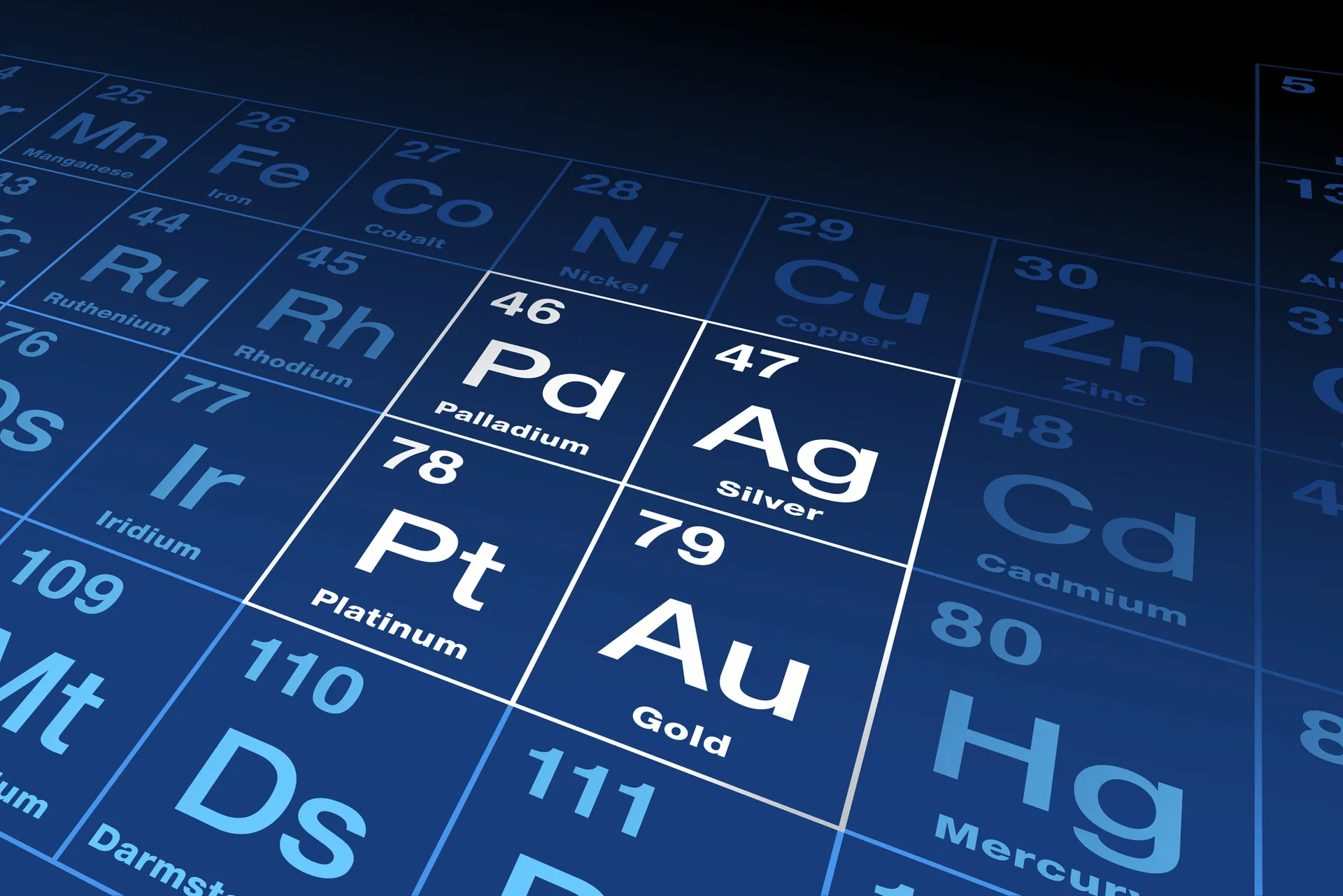
Finally, we curated our selections to cover the four primary precious metals available in ETF form: gold; silver; platinum; and palladium.
We also included one option that provides diversified exposure across multiple metals, allowing investors to own the entire basket through a single holding.
SPDR Gold Shares

- Expense ratio: 0.40%
- Assets under management: $154.2 billion
- 30-day median bid-ask spread: 0.01%
- Five-year annualized return: 20.5%
Gold has maintained monetary relevance for thousands of years, in part because its supply grows slowly and predictably. New production is constrained by the high cost and long timelines required to discover, permit and extract the yellow metal, which gives it deflationary scarcity.
Moreover, central banks around the world continue to hold gold as a reserve asset, reflecting its role as a neutral store of value across political systems and economic regimes.
SPDR Gold Shares (GLD) was the first physically backed gold ETF to trade in the U.S., and it remains the largest today. Launched in November 2004, GLD has become the default vehicle for gold exposure for many investors.
GLD isn't the cheapest gold ETF on the market, but its defining strength is liquidity. As of August 21, it trades more than 8 million shares per day across major U.S. exchanges, with an extremely tight bid-ask spread. This depth of liquidity makes it one of the most efficient ways to gain or exit gold exposure at scale.
The ETF is physically backed, with its gold reserves held by custodians including HSBC Bank and JPMorgan Chase Bank. The trust is sponsored by World Gold Trust Services, with The Bank of New York Mellon serving as trustee.
GLD is suitable for long-term investors who value scale and liquidity, though cost-conscious investors might prefer alternatives. A common lower-cost option is the SPDR Gold MiniShares Trust (GLDM), which charges a 0.10% expense ratio, roughly a quarter of GLD's fee.
Where GLD truly stands out is versatility for traders. The ETF has an active options market, with weekly expirations and a wide range of strike prices. This allows investors to hedge positions using puts or generate income through covered calls.
Learn more about GLD at the State Street provider website.
iShares Silver Trust

- Expense ratio: 0.50%
- Assets under management: $34.2 billion
- 30-day median bid-ask spread: 0.02%
- Five-year annualized return: 24.1%
Silver tends to play second fiddle to gold in the precious metals hierarchy. Unlike gold, silver is not held in meaningful quantities as a reserve asset by central banks. While it does have jewelry and investment demand, modern silver usage is far more tied to industrial applications.
Silver is a key input in electrification, including solar panels, electric vehicles, batteries, semiconductors and a wide range of electronics. As global energy transition efforts expand, silver demand is increasingly linked to real economic activity, especially in emerging markets like China.
In ETF form, the iShares Silver Trust (SLV) is to silver what GLD is to gold. Launched in April 2006, it has one of the longest track records among physically backed silver ETFs. The fund tracks the LBMA Silver Price and holds slightly more than 15,295 metric tons of silver in trust, which translates to approximately 491,754,305 ounces.
Liquidity is a defining feature. SLV trades with a consistently tight bid-ask spread and extremely high volume. On August 21, nearly 23 million shares changed hands, making it one of the most actively traded commodity ETFs in the market.
One important nuance for investors to be aware of is that recent surging demand for silver has occasionally strained the ETF's creation and redemption process. As of August, SLV was trading at a slight discount to its net asset value.
Like GLD, SLV also benefits from a very active options market. Weekly expirations and a wide range of strike prices make it suitable for tactical strategies, including buying put options for downside protection or selling call options and puts to generate income.
Learn more about SLV at the iShares provider site.
Aberdeen Physical Platinum Shares ETF

- Expense ratio: 0.60%
- Assets under management: $2.3 billion
- 30-day median bid-ask spread: 0.21%
- Five-year annualized return: 12.9%
Platinum is one of the most valuable metals you won't often see but almost certainly rely on. It's prized in jewelry for its corrosion resistance, but its importance today is far more industrial than decorative.
Platinum plays a critical role in catalytic converters, where it helps reduce harmful emissions from internal combustion engines. That concentration of platinum is also why catalytic converters have become frequent targets for theft.
Beyond automobiles, platinum is widely used in chemical processing, petroleum refining and medical devices. Combined with its limited supply and high extraction costs, these uses place platinum firmly within the precious metals category.
For investors, gaining exposure to platinum is not as straightforward as gold or silver. ETF options are limited, and the most established choice is the Aberdeen Physical Platinum Shares ETF (PPLT). While it's not the most liquid ETF in the space and carries a wider bid-ask spread, PPLT offers direct, physically backed exposure to platinum.
PPLT is managed by Aberdeen, an asset manager with a longstanding specialization in precious metals. The fund holds physical platinum stored with ICBC Standard Bank in the United Kingdom, with The Bank of New York Mellon serving as trustee.
Transparency is a defining feature. The holdings are audited regularly, and investors can access detailed bar lists showing serial numbers, weights and storage locations, along with vault inspection reports from independent auditors.
Learn more about PPLT at the Aberdeen provider site.
Aberdeen Physical Palladium Shares ETF

- Expense ratio: 0.60%
- Assets under management: $707.8 million
- 30-day median bid-ask spread: 0.11%
- Five-year annualized return: -10.5%
Also tucked away inside your car's catalytic converter is palladium. While it's far less common in jewelry than gold or platinum, palladium plays a critical role in emissions control.
Outside of catalytic converters, palladium also sees use in electronics, dental applications, chemical processing and certain hydrogen-related technologies. Even so, it has remained largely overshadowed by other precious metals in investor portfolios.
In the past five years, palladium has notably underperformed, posting negative returns while gold, silver and platinum all experienced strong rallies. That divergence might interest value-oriented precious metals investors.
For ETF exposure to palladium, the Aberdeen Physical Palladium Shares ETF (PALL) is one of the few options available. As with its sibling fund PPLT, it's managed by Aberdeen and uses a physically backed grantor trust structure.
While the expense ratio is higher than that of gold and silver ETFs and liquidity is more limited, the fund provides direct exposure to palladium spot prices without any derivative gimmicks.
PALL uses ICBC Standard Bank as its custodian, with the Bank of New York Mellon acting as trustee. Transparency is consistent with Aberdeen's precious metals lineup. Investors can access detailed bar lists showing serial numbers, weights and storage locations, along with auditor vault inspection reports.
Learn more about PALL at the Aberdeen provider site.
Aberdeen Physical Precious Metals Basket Shares ETF

- Expense ratio: 0.60%
- Assets under management: $2.9 billion
- 30-day median bid-ask spread: 0.28%
- Five-year annualized return: 18.3%
If your goal is maximum diversification within the precious metals segment, the Aberdeen Physical Precious Metals Basket Shares ETF (GLTR) is the most straightforward option. GLTR is Aberdeen's all-in-one solution for owning the entire precious metals universe in a single vehicle.
GLTR holds physical gold, silver, platinum and palladium, weighted roughly by their respective market sizes. Gold sits at the top, followed by silver, with smaller allocations to platinum and palladium.
Rather than making a bet on the supply, demand or industrial dynamics of any single metal, this structure lets you express a broader view on precious metals as an asset class.
That makes GLTR best suited for portfolio construction purposes. Investors who already hold diversified global stock and bond exposure across sectors might want precious metals as a non-correlated sleeve rather than a tactical trade.
GLTR fits that role well by spreading risk across multiple metals, each with different demand drivers and economic sensitivities.
The trade-off is cost and liquidity. GLTR carries the same relatively high expense ratio as Aberdeen's single-metal ETFs, and its trading spreads are wider than those of gold or silver ETFs. For long-term holders using it as a strategic allocation, those drawbacks might be acceptable.
Learn more about GLTR at the Aberdeen provider site.
Related content