Nasdaq Falls 626 Points to Start Nvidia-Anthropic Week: Stock Market Today
It's no exaggeration to say this is the biggest week of the year for the stock market, and the beginning of it was inauspicious, at best.

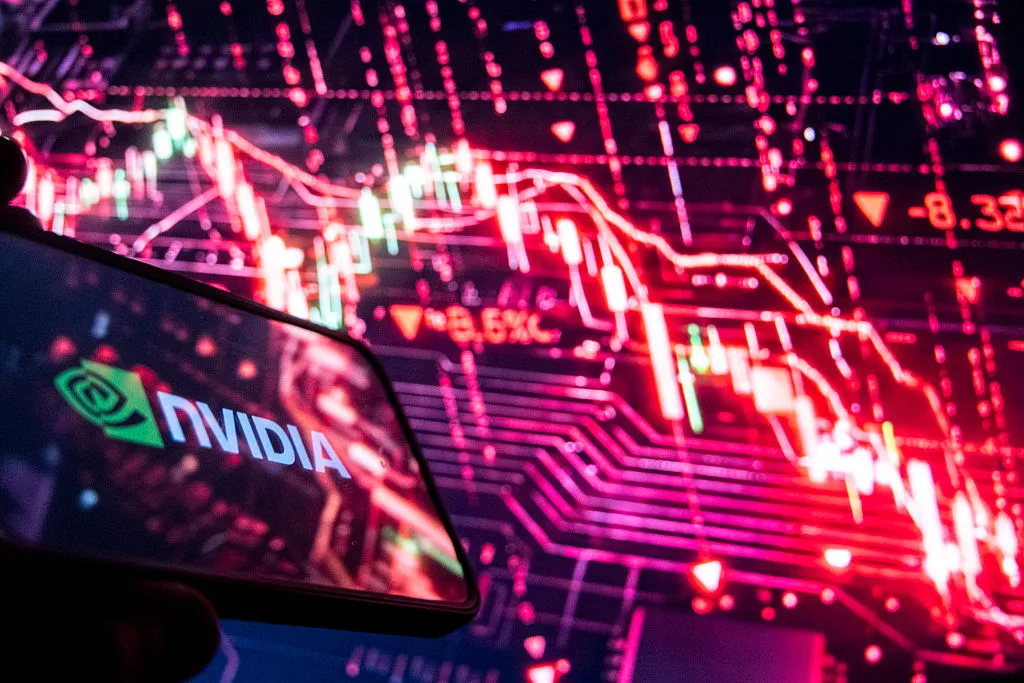
Stocks gapped down at Monday's opening bell after a weekend filled with speculation about the future of the leader of the AI revolution, as Nvidia (NVDA) prepares to report results after Tuesday's closing bell without Jensen Huang. Anthropic is on track to complete its initial public offering (IPO) on Wednesday, while Fed Chair Kevin Warsh suggested the U.S. can't sustain its superpower status without leading on AI.
During opening remarks at a symposium on how artificial intelligence will work its way into the broader economy, Warsh said members of the central bank's research staff are studying what it means for workers, as well as the implications of a burst bubble.
The Fed chair said productivity growth is reasonably strong right now but hasn't broken out, suggesting AI's promise remains further in the future.
From just $107.88 $24.99 for Kiplinger Personal Finance
Become a smarter, better informed investor. Subscribe from just $107.88 $24.99, plus get up to 4 Special Issues

Sign up for Kiplinger’s Free Newsletters
Profit and prosper with the best of expert advice on investing, taxes, retirement, personal finance and more - straight to your e-mail.
Profit and prosper with the best of expert advice - straight to your e-mail.
As Nick Timiraos of The Wall Street Journal reports, "Warsh's remarks repeatedly cast AI as a question of national power, a theme upon which Fed chairs haven't typically dwelled. He recalled the late economist Robert Mundell calling America's rise as a superpower the most important fact of the 20th century, and said for the U.S. today, 'it is a charge to keep.'"
Focused on the bigger picture, Warsh offered no commentary on recent price action, the short-term trajectory of inflation or the Fed's current stance on interest rates.
Is Jensen Huang still Nvidia's 'key man'?
Nvidia fell another 4.1% amid reports that big players at major Silicon Valley venture capital firms are privately advocating for Jensen Huang's return as CEO. NVDA is now down 10.1% since Huang resigned last Thursday.
Though President Donald Trump, Bill Ackman and Elon Musk have publicly expressed their support for the fallen executive, CNBC says the Nvidia board will not heed their call. The board is already dealing with as complex a succession crisis as you'll find in the real world these days.
Indeed, as Noah Weisberger and Yifei Liu of BCA Research conclude, the surprise exit of a CEO is a meaningfully negative event "particularly if the departure is driven by a legal or ethical issue."
Based on a total of 30 cases, Weisberger and Liu found that stocks underperform by about 7% in the month after an unexpected CEO departure, and 70% of them lag. The data show that legal/ethical departures cost about 13%. Stocks recover within a month when the cause of the departure is death or illness.
The good news is their data show that the impact of such events is less negative for its sector. Even better, history reveals no meaningfully negative impact on the broader market. Sectors slip less than 0.5%, and S&P 500 returns are normal.
Looking for more timely stock market news to help gauge the health of your portfolio? Sign up for Closing Bell, our free newsletter that's delivered straight to your inbox at the close of each trading day.
At the same time, Weisberger and Liu caution that because of its weight in the index (about 7% at the time of their research), Nvidia's "key man risk could spread further than the history suggests."
Meanwhile, Chief Financial Officer and interim CEO Colette Kress will lead Nvidia's fiscal 2027 third-quarter conference call from beginning to end after the closing bell on Tuesday.
We're following news and developments about the chip stock and its leadership crisis on our Nvidia earnings live blog.
ANT joins the Nasdaq
The Anthropic IPO is expected to price on Wednesday evening, and the stock should start trading on the Nasdaq under the ticker symbol "ANT" on Thursday.
Northwestern Mutual Wealth Management Chief Investment Officer Brent Schutte is watching the Anthropic IPO as "a sign of just how much capital AI requires," citing a Bloomberg report that management is looking to raise $90.4 billion and comparing its plans with the $98 billion Meta Platforms (META, -2.4%) is raising to fund its AI business.
"So far this year," Schutte writes, "over $425 billion has been raised across listed U.S. companies, according to Bloomberg. With rates rising, the cost of all that capital matters even more."
CAT drags the Dow
By the closing bell, the tech-heavy Nasdaq Composite was down 2.5% at 24,509, the broad-based S&P 500 had fallen 1.9% to 7,416, and the blue-chip Dow Jones Industrial Average was lower by 1.4% at 51,608.
Alphabet (GOOGL, -4.1%) and Amazon (AMZN, -3.3%) joined Nvidia near the bottom of the index, but Caterpillar (CAT, -5.0%) was the worst Dow Jones stock on Monday, as the broad AI trade continues to unwind.
On the plus side of the ledger, Tyson Foods (TSN) was the top-performing S&P 500 stock after management of the food processing company reported better-than-expected fiscal fourth-quarter earnings and shared an upbeat forecast.
TSN was up as much as 11% on Monday, as consumer staples and utility stocks were alone among the 11 stock market sectors defined by S&P Global to close in positive territory.
Related content
- This Volatile State Street ETF Requires Patience From Investors
- The Kiplinger Dividend 15: Our Favorite Dividend-Paying Stocks
- Why Avoiding Capital Gains Can Sometimes Cost You More