10 Things You Should Know About the Inheritance Talk
Are your kids ready for what you're leaving them?


More than $120 trillion will pass between generations over the next two decades. Members of the baby boomer and Silent generations managed to accumulate unprecedented amounts of wealth as the stock market became more accessible, homeownership and home values rose, and retirement tools like 401(k)s and IRAs turned workers into long-term savers and investors.
But as bank accounts and net worths swelled, Americans didn't all suddenly become comfortable talking about money.
Kiplinger commissioned Morning Consult to conduct a survey to better understand Americans' feelings and beliefs about inheritance, including how prepared they feel – and how prepared they actually are. The survey reached 2,500 adult children (ages 25-60) with at least one living parent and 2,500 people aged 55+ with at least one adult child. Our research uncovered many potential problems in families' futures, many of which could be solved with open, ongoing conversation.
From just $107.88 $24.99 for Kiplinger Personal Finance
Become a smarter, better informed investor. Subscribe from just $107.88 $24.99, plus get up to 4 Special Issues

Sign up for Kiplinger’s Free Newsletters
Profit and prosper with the best of expert advice on investing, taxes, retirement, personal finance and more - straight to your e-mail.
Profit and prosper with the best of expert advice - straight to your e-mail.
Here are 10 things we learned:
1. More parents plan to leave an inheritance than children expect one
Our research showed there's already a disconnect at a very basic level of understanding. Nearly 50% of the parent generation said they plan to leave a meaningful inheritance, but only 24% of children are expecting one.
Additionally, there's a disconnect in expectations of what makes up parents' estates. Half of parents said traditional or Roth IRAs and 401(k)s are in their estate, but only a third of the younger generation said they believe that's in their parents' estate. Moreover, 54% of parents said real estate is in their estate, but only 32% of children said the same.
2. Inheritance surprises can lead to problems
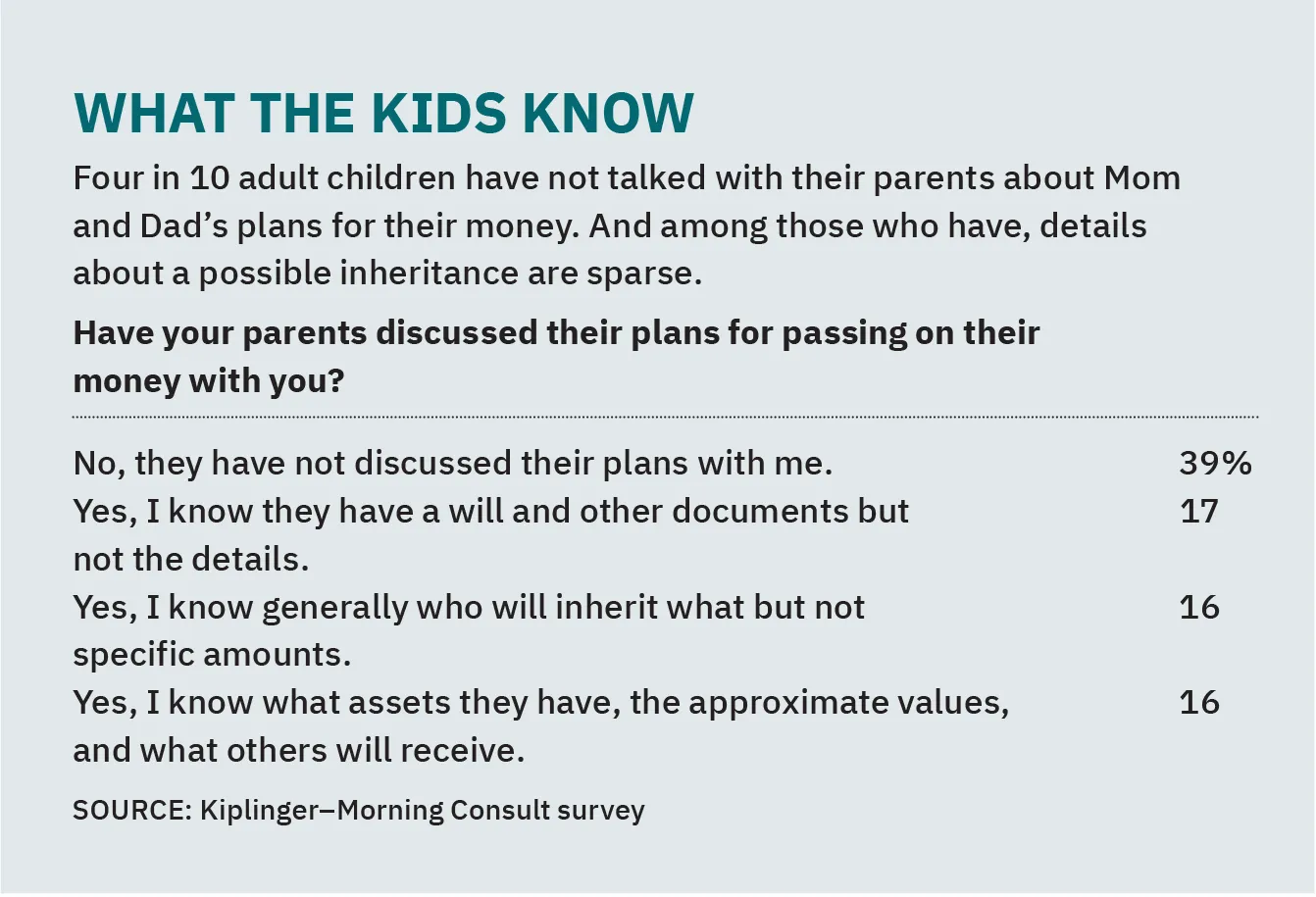
These disconnects mean we potentially have a huge number of Americans soon to be surprised by an inheritance. While a surprise inheritance may not sound like a bad thing, a lack of preparedness can present issues.
Take IRAs: The IRS requires that non-spousal beneficiaries of IRAs must clean out the account by the end of the 10th year after the owner's death. If an heir isn't aware of those rules, they're in for a tough surprise.
There are similar potential problems with real estate. Leaving a house to an heir sounds like a gift unless you've prepared them for ownership costs like property taxes, HOAs and utility bills. And leaving behind a family home to multiple siblings without having a conversation about it could lead to infighting and messiness.
Read more: About 40% of Heirs Say They Can’t Afford an Inherited Home
3. Two in five families have never discussed inheritance
There's one number we have close agreement on between generations: 38% of parents and 39% of the younger generation say they have not discussed their plans for their assets.
4. The less wealth involved, the less they've talked

Nearly half of parents with an estimated estate under $100,000 have not discussed plans with their kids; that number drops to just 25% for parents with an estimated estate over $500,000.
The Great Wealth Transfer isn't going to hit everyone evenly, just as wealth accumulation hasn't hit everyone evenly. In fact, an estimated 2% of all households account for more than half of the expected Great Wealth Transfer.
But just because you think your estate may not be enough to fill a whole conversation doesn't mean you should avoid talking about it. More often than not, it's sentimental items, not valuable ones, that cause disputes between families.
Read more: Why Leaving an Equal Inheritance to Your Children Could Backfire
5. Anxiety about what will be left fuels avoidance
Among the older generation who said they haven't discussed estate plans with their children, the most cited reason for avoiding it was that "there are too many unknowns about how long I will live or how much will be left."
Three in 10 parents worry about how much will be left in their estate given inflation and economic pressures, while about a quarter worry about long-term care and healthcare costs depleting their estate.
6. Many people have no idea what to expect
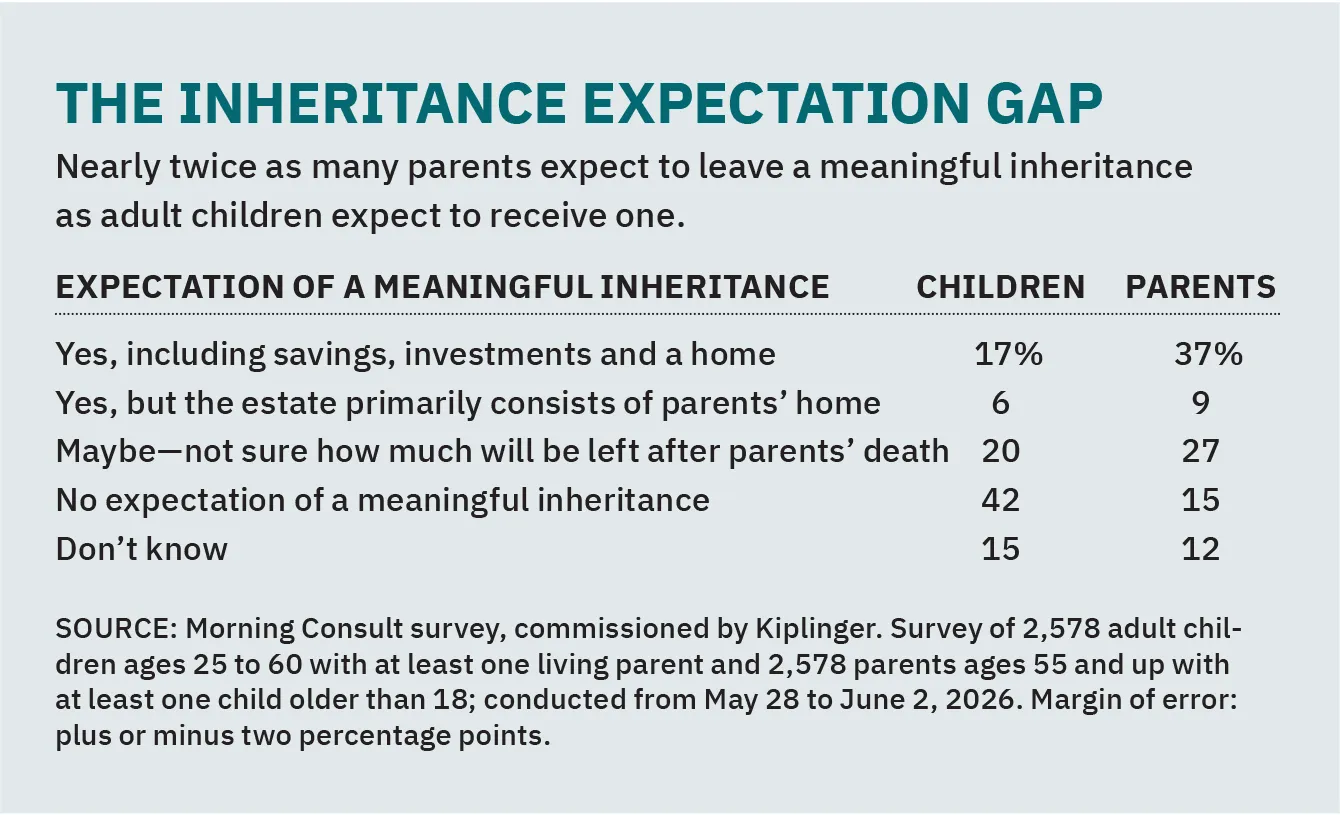
About two-in-five people, among both parents and children, said they don't know or have no opinion about how much will be inherited.
Among those who did name a number, 17-18% said less than $10,000; 3% of the younger generation and 5% of the elder generation said more than $1,000,000.
Read more: No One Wants to Ask Their Aging Parents About Their Finances, But Here's How
7. But an exact number isn't necessarily key
"Inheritance is never only about money," Valerie Galinskaya, managing director and head of the Merrill Center for Family Wealth, said in our Kiplinger Conversation about inheritance. Yes, having a general idea about if they should be expecting $10,000 or $1,000,000 is helpful for heirs, but they also want to understand why their parents made certain decisions around the inheritance and how it's split among beneficiaries.
We asked the younger generation the one question they would ask their parents about a possible inheritance, and while 18% give a version of "how much will I receive?" a near-equal 16% say they had no questions, while 12% would ask emotional questions, like if their parents enjoyed their lives.
8. Having a plan for a conversation is helpful

A little preparation goes a long way to helping your heirs understand your plan. A Merrill Center for Family Wealth survey of wealthy families found that 78% who recently had conversations about wealth had them spontaneously – and 26% said they regretted those conversations.
But that doesn't mean you have to have your estate plan perfectly mapped out and a speech fully scripted. You should consider the setting of a conversation as well as the timing, and if you have multiple heirs, consider if you want to talk to them together or independently.
"Think of estate planning as a process," said Ryan Coon, attorney at Anderson Advisors, in our Kiplinger Conversation. It's not a single event; it's a process that develops over time — and your conversation should work the same way. Perhaps it's a hard truth, but the truth is, the best inheritance talk is actually many conversations throughout a lifetime, not a single perfect conversation.
Read more: How to Talk to Your Adult Kids About Their Inheritance
9. Estate planning tools can help explain
There are certainly cases where you're unable to have a conversation at all. This can happen if, for example, you have an estrangement with an heir, if a beneficiary has a learning disability, if you have a medical incident that leaves you unable to discuss the plan, or if, simply, the timing just doesn't work.
If you're concerned about not being able to convey your wishes to your heirs, there are tools within estate planning to use. First and foremost, you can write a letter of intent to be given to your heirs to explain the estate plan. You can also construct trusts to have funds be used in certain ways, if you have specific intentions for what you're leaving. In all cases, working with a trusted estate planning attorney will help. You can find them from personal recommendations or directories from sources like the National Association of Estate Planners and Councils or the American College of Trust and Estate Counsel.
Read more: The 5 Essential Trusts You Need for 2026 Estate Planning
10. People want to help their families
We asked parents what they hope their children will use an inheritance for, and the most popular answer was a version of "to improve their lives and comfort." When we asked the younger generation what they hope to do with an inheritance, their most popular answer was a version of providing for their own family or helping others.
"I want them to be happy," one parent wrote, "and also be good stewards of their finances."
Note: This item first appeared in Kiplinger Retirement Report, our popular monthly periodical that covers key concerns of affluent older Americans who are retired or preparing for retirement. Subscribe for retirement advice that's right on the money.
Related Content
- Kiplinger's Trillion Dollar Talk
- Trillions of Dollars Will Be Passed Down in the Next 20 Years and Many Families Are Totally Unprepared: What to Know and What to Do
- How 30 Everyday Millionaires Are Splitting Their Inheritances and Discussing Money With Their Kids