How to Talk to Your Adult Kids About Their Inheritance
The Great Wealth Transfer starts with a conversation. Here's how to prepare heirs, reduce future conflict and create a lasting legacy.


Joseph Moore's oldest daughter was 10 years old when she raised the question some parents dread: Are we rich?
She'd noticed that, unlike her friends, she lived in a gated golf course community with celebrities as neighbors, Moore says. The family's affluent lifestyle reflected the wealth Moore had built through real estate investing. But he was quick to challenge his daughter's assumption.
"I said to her, 'No, I'm rich,' " Moore says. "'You have what you've put in your savings account.'"
From just $107.88 $24.99 for Kiplinger Personal Finance
Become a smarter, better informed investor. Subscribe from just $107.88 $24.99, plus get up to 4 Special Issues

Sign up for Kiplinger’s Free Newsletters
Profit and prosper with the best of expert advice on investing, taxes, retirement, personal finance and more - straight to your e-mail.
Profit and prosper with the best of expert advice - straight to your e-mail.
The distinction was intentional. Moore wanted his daughter to understand he had worked to create his wealth, and she would have to do the same to create her own fortune.
That doesn't mean that Moore's oldest daughter and her younger sister won't benefit from the wealth he has amassed. Rather than save the conversation for adulthood, Moore has a multiphase plan for talking with his daughters, now 13 and 6, about money and how he will share his assets with them. The framework grew out of research for his best-selling book, How to Get Rich in American History: 300 Years of Financial Advice That Worked (& Didn't).
He's already started teaching them basic financial concepts and money-management skills. With his teenager, he has moved on to explaining the kinds of opportunities he'll pay for, such as college, a down payment on a home or a business venture. When his daughters are mature enough, he will share details about what assets he will pass on to them and others, including charities.
"I'd much rather them be handed these things in phases than think that there's some huge pot of gold that they're going to get at my demise," Moore says. The real inheritance he hopes to leave his daughters, he says, is competence: "That to me is the lesson of history, that competence outperforms trust funds."
Most families don't take such a deliberate approach. More than half of parents ages 55 and older surveyed by Morning Consult for Kiplinger say they rarely or never discuss money with their children.
Talking about inheritance is even more taboo. Both generations rank it as one of the most challenging topics to raise — more uncomfortable than talking about mental health, politics, or even your end-of-life wishes and funeral arrangements.
Financial experts say that avoiding these conversations can leave children unprepared to manage wealth and families vulnerable to confusion or conflict when assets eventually change hands.
"I have seen many families really struggle, be torn apart due to surprises about things that came out after people passed away," says Ruschelle Khanna, a therapist with 25 years of experience working with high-net-worth families and author of Inherited Trauma and Family Wealth.
One reason many find it difficult to have these discussions is that there's little historical precedence for having them, Moore says. In the past, few families had the type of wealth that could be bequeathed to the next generation. Since the shift from pensions to 401(k)s began in the early 1980s, Americans have been retiring with more liquid assets that can be passed on when they die, Moore says.
Known as the Great Wealth Transfer, $105 trillion is expected to be handed down — largely by high-net-worth households — to heirs through 2048, according to the consulting firm Cerulli Associates. After removing the top 1% from the equation, there's still an estimated $36 trillion that will be transferred from boomers to their Gen X and millennial children over the next two decades, according to Visa Business and Economic Insights.
"This is a newer conversation for middle-class families," Moore says. "If your parents didn't sit you down and explain how you were going to inherit your wealth, you don't know how to do it with someone else."
That doesn't mean you can't learn. Experts say productive inheritance conversations aren't about revealing dollar amounts all at once. Instead, they recommend treating them as an ongoing dialogue that evolves with your child's age and maturity and any changes in your own circumstances or views. Here's how to start.
The case for talking about inheritance

When it comes to inheritance, there's a transparency gap. Nearly half of parents expect to leave money or assets to loved ones when they die, but only about one-fourth of adult children expect to receive an inheritance, according to the Kiplinger–Morning Consult survey.
The most-common reasons parents give for not talking are that there are too many unknowns, they don't have a clear plan or that they simply haven't gotten around to having the conversation, the survey found.
"I have had clients say, 'I don't care what happens because I'll be dead,'" says Sandi Bragar, chief client officer at wealth management firm Aspiriant in San Francisco.
If you die without any estate-planning documents, such as a will or trust, that spell out who gets what when you die, your state's laws will determine how your assets will be distributed. "People of all net worths ought to have a plan," says Michael Whitty, an estate-planning attorney with Smith, Gambrill and Russell in Chicago. "Even if they are of very modest means, they should have at least a will."
Online will and trust creation services, such as LegalZoom, Trust & Will and Quicken WillMaker & Trust, are low-cost options. However, Whitty advises working with a professional who can ask the right questions about your wishes to tailor estate-planning documents to your needs, rather than trying to rely exclusively on self-help services.
Once you have a plan, it's important to let your family know that you have one and to share some details. "One of the biggest mistakes is not communicating with your children or asking your advisers to communicate on your behalf," says Dawn Jinsky, a partner with Plante Moran Wealth Management in Ann Arbor, Michigan. "They need to hear it from you."
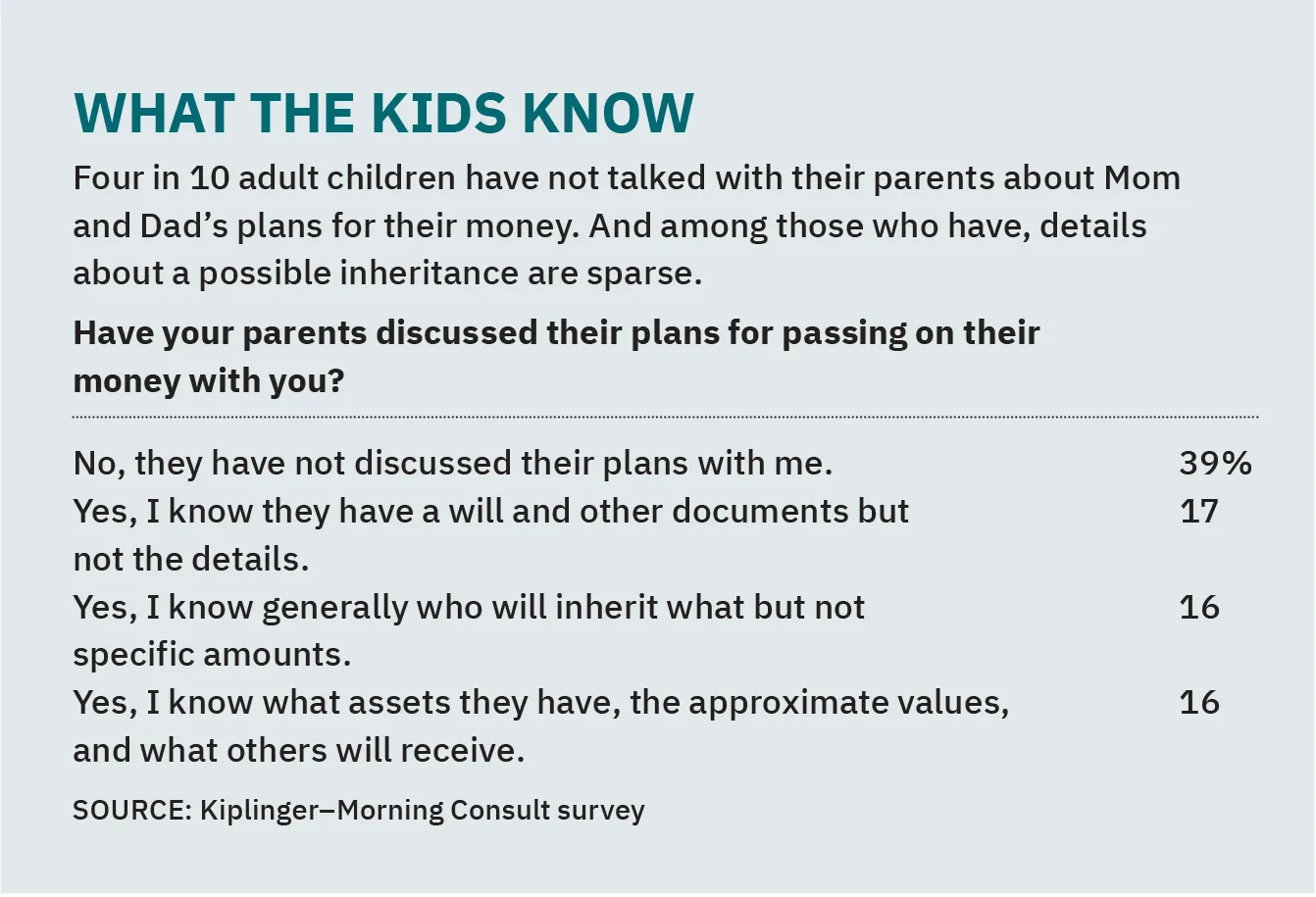
If they don't, your children could make assumptions about the reasons you won't share inheritance information with them. They might think that you don't trust them with money, Jinsky says. Or they might have unrealistic expectations about what they will inherit.
Lack of communication can also leave children unprepared for the wealth they receive or roles they'll have to fill. "For example, if a child is meant to become a trustee of a trust, we want to help the client make sure the child has the skills and competency to fulfill the responsibilities of the trust," Bragar says.
Plus, an unwillingness to discuss your plan and explain the reasoning behind your decisions can lead to resentment or disputes among your children.
"There are plenty of stories of families throughout history who go to the will reading to find out that what they had assumed would be a fair and equitable distribution was not," Moore says. "Your legacy is forever locked into that last moment of conflict."
When to have conversations about inheritance

The best time to start talking about inheritance isn't when you're drafting your estate plan. Ideally, parents should start laying the foundation for discussions as soon as their children can understand the concept of money. "The families that do this the best begin as young as possible," Khanna says.
When children are in elementary school, conversations can focus on family values and money-management basics. As children mature, parents can gradually introduce more information about family finances, including goals for their wealth and, eventually, details about their inheritance planning, Whitty says. The goal is to avoid leaving children to fill in the blanks.
"If you're silent, the kids might think, I don't know if I'll get anything, but I may get a lot," Whitty says. "That could distort their motivations about their own careers, personal development, even their choice of a potential spouse."
Parents who missed earlier opportunities shouldn't assume they have waited too long. Experts say discussions with adult children are essential — as long as they happen before a crisis forces the issue.
"I'm sure a lot of these conversations occur on the deathbed," says David Russell, a wealth adviser with Argent Trust in Ridgeland, Missouri. "At that time, it's too late to do anything planning-wise."
Don't let reluctance to talk hold you back. "If you're not ready to jump into the conversation, find an adviser as soon as possible," Khanna says.
She recommends working with a financial planner with experience facilitating family money talks. (You may be able to find one using the directory at 2164.net/advisors, which lists financial pros who focus on multigenerational planning and family philanthropy.)
If emotional barriers are getting in the way, a financial therapist can help you address fears that are preventing you from sharing inheritance information with your children. You can find a financial therapist through the Financial Therapy Association
What to share about inheritance

Before you talk, Bragar recommends identifying what you hope to achieve. "How do you want your family to think about the wealth that will be left?" she says.
"When people care about their family members and want there to be some level of harmony, it's easier to go into the conversation when you visualize what is important."
Then, consider the questions your children might have. "What type of information might they need about you to live their lives stress-free?" Bragar says. For example, they might be wondering whether you have enough money to live comfortably in retirement or to pay for long-term care.
Bragar says some parents are reluctant to spend savings because they want to leave more for their children — even though that can be the last thing the children want.
Russell has what he calls "who does what when" meetings with his clients and their children to foster conversations about both wealth transfer and long-term-care planning. The focus on logistics can help keep emotions at bay to ensure a more productive discussion, he says.
To replicate the process, parents can create three columns on paper or a computer document to list the people they expect to be involved with their finances as they age and after they die, what role each person will play, and when they are expected to fill those roles. Parents could add a fourth "Why" column to explain the reasoning behind their choices, Russell says.
How do you want your family to think about the wealth that will be left?
Sandi Bragar
Note that there's not a column for "How much." Russell says that most of his clients aren't willing to share the details of how much they have.
Other financial advisers meet with the same resistance. "Clients feel like communication means opening the curtain and sharing everything," Jinsky says. "You don't need full transparency with your children."
There are a handful of reasons why it could make sense not to share specifics about how much your children or family members will inherit. For starters, you might end up needing to spend more of your savings than you think, especially if dementia or another chronic condition forces you to pay hundreds of thousands of dollars for many years of care.
Another reason: You might change your mind. "Don't lock yourself into a conversation your children will remember," Jinsky says. For example, one of her clients who lived to age 96 changed her estate-planning documents 32 times — every time she did or didn't get a call on her birthday.
However, Jinsky cautions that full disclosure is needed in some circumstances, such as when you've legally appointed your child to manage your assets when you die. "If you're in your eighties and your child is the trustee, that is a pull-the-curtain-and-share-everything moment," she says.
Another reason parents might opt for sharing some details with children about what they can expect to inherit or receive while you're still living: If knowing, even just broad ranges, might help them make more-informed financial and estate-planning decisions in their own lives, Whitty says.
How to keep inheritance conflict to a minimum

Experts recommend having a family meeting with all of your children to share your inheritance plans if everyone gets along well. This holds true even if you plan to divide your assets unevenly or give the bulk of your wealth to charity, your place of worship or a similar organization.
Children who are mature and have a strong relationship with their parents and each other should understand why, for example, their parents plan to give more to a child with special needs, Whitty says.
When a family meeting isn't the best choice: "If there is resentment, jealousy or in-fighting, or any sort of disrespect, maybe you want to have those conversations individually," Khanna says. It also can be helpful to have a third party, such as an attorney, financial adviser or therapist, mediate potentially difficult inheritance talks to "slow the conversation down and hold space for big feelings," she says.
Another option is to write letters to your children to explain your decisions. This tactic can also be effective if you have children who are unwilling to engage in a conversation because of their fears about aging and death, Khanna says.
Although it's your money at the end of the day, and the approach you choose is ultimately up to you, Khanna says, "I always try to encourage families to make compassionate decisions knowing the impact it will have on people."
Note: This item first appeared in Kiplinger Personal Finance Magazine, a monthly, trustworthy source of advice and guidance. Subscribe to help you make more money and keep more of the money you make here.
More Trillion Dollar Talk
- Being an Executor is a Thankless Job: Here's How to Do It Well Anyway
- These Are the 2 Legal Documents Everyone Should Have, Courtesy of an Estate Planning Attorney
- Is Your Will 'Fair'? Estate Planning Is About More Than Money
