5 Stocks to Buy Before the Next AI Demand Shock Hits
From power grids to memory chips, these five high-growth AI infrastructure stocks are poised to capitalize on bottlenecks and big spending.


For years, the artificial intelligence (AI) trade looked deceptively simple: Buy Nvidia (NVDA), collect the upside, repeat. That was the right call in 2023. It's a much smaller part of the story today.
To understand why, it helps to rewind further than the AI boom itself — look to 1990, when American factories made 37% of the world's semiconductors. By 2020, that share had collapsed to just 12%, according to data compiled by the Semiconductor Industry Association and the Boston Consulting Group. Analysts expect it to keep sliding as new fabrication capacity keeps getting built in Asia instead.
Chips were hardly the only casualty. Over three decades, the United States systematically outsourced or underbuilt the physical capacity behind huge swaths of its economy — power generation and grid equipment, industrial-scale manufacturing, advanced packaging, precision optics. For a long time, it was simply cheaper to let someone else own the factories.
From just $107.88 $24.99 for Kiplinger Personal Finance
Become a smarter, better informed investor. Subscribe from just $107.88 $24.99, plus get up to 4 Special Issues

Sign up for Kiplinger’s Free Newsletters
Profit and prosper with the best of expert advice on investing, taxes, retirement, personal finance and more - straight to your e-mail.
Profit and prosper with the best of expert advice - straight to your e-mail.
Then the AI boom arrived, and it didn't ask permission. Big Tech's combined capital spending on data centers and AI infrastructure has gone from roughly $142 billion in 2022 to somewhere around $600 billion this year, by one widely cited industry tally — a more than fourfold increase in four years.
Alphabet (GOOGL) raised its 2025 capital budget three separate times, from $52.5 billion in 2024 to as high as $93 billion; Microsoft (MSFT) spent $34.9 billion in a single quarter, up 74% from a year earlier; Amazon (AMZN) guided to $125 billion for 2025, a 61% jump from the year before.
Goldman Sachs now projects that Meta Platforms (META), Microsoft, Amazon and Alphabet alone will spend a combined $5.3 trillion on capital expenditures between fiscal 2025 and fiscal 2030.
Put those two forces together — decades of underbuilt physical capacity meeting trillions of dollars a year in fresh demand — and you get something predictable: a chain of demand shocks, moving one link at a time through the AI supply chain, each one temporarily handing pricing power to whichever supplier happens to be sitting in the bottleneck.
The pattern is already well established. It hit GPUs first: Nvidia's full-year data center revenue for its most recent fiscal year came in at $194 billion, up 68% from a year earlier and nearly 13 times what it was when ChatGPT launched, with gross margin holding above 75%. It hit server assemblers such as Dell (DELL) and Super Micro (SMCI) next.
Then it hit power: Nuclear operator Constellation Energy (CEG) has been signing long-term supply contracts at prices running $30 to $40 above prevailing regional electricity rates, and its adjusted per-share earnings rose more than 25% last quarter alone.
It hit memory next, with Micron's (MU) high-bandwidth chips sold out through the end of the year, while gross margins have rocketed into the mid-80s from below 40% a year ago.

Now it's moving into optical connectivity and the specialized chips that shuttle data between GPUs inside a server rack.
Each shock eventually cools as new supply comes online and the crowd catches on. But the capital behind it keeps moving to the next bottleneck, and there's a lot more of it coming. PwC's Global Data Centre Outlook now projects $31.6 trillion of cumulative AI-era data center spending through 2050, with annual spending climbing from roughly $800 billion this year to $1.1 trillion by 2030 and $1.8 trillion by mid-century.
Unlike prior infrastructure booms that front-loaded spending and tapered off, this one requires the equipment inside data centers — GPUs, servers, memory, networking gear — to be replaced every four to six years, indefinitely, which is why PwC expects the annual bill to keep rising rather than fall back once the initial buildout is done.
That's the setup for the five stocks below. Each one sits on a supply-constrained bottleneck currently absorbing part of that spending — some already well into their shock, some just getting started.
GE Vernova: The power bottleneck
AI's biggest constraint today isn't chips — it's electricity, and gigawatts of new capacity don't get built overnight. GE Vernova (GEV) makes the gas turbines and grid equipment utilities need to add that capacity, and demand is outrunning what the company can ship.
In its most recent quarter, revenue reached $11.1 billion, with power segment orders up 134% and electrification orders up 66%, both organically. Management now expects its order backlog — already north of $160 billion — to cross $200 billion by the end of 2027, a year earlier than it guided at the start of the year.
Microsoft has already lined up seven of the company's gas turbines for a Texas data center project alongside Chevron (CVX), and similar deals are stacking up across the industry. The industrial stock has already made an enormous move, so consider buying dips rather than chasing new highs.
Corning: The optical pipes

Every AI data center needs physical fiber to connect its racks at the speeds modern GPUs demand, and Corning (GLW) still invents more of that fiber than any company on Earth. In its latest quarter, core sales rose 17% to $4.74 billion and operating margin expanded nearly two full percentage points to 20.9%.
Inside that number, sales tied specifically to AI data centers nearly doubled vs the prior quarter, said Edward Schlesinger, Corning's chief financial officer, in the earnings call..
Corning has also locked in a deepened fiber-optic manufacturing partnership with Amazon and a separate multiyear agreement worth up to $6 billion to wire Meta's next-generation AI data centers.
The company's own long-term plan calls for sales to nearly double, from a $20 billion annualized run rate this year to $30 billion by 2028 and $40 billion by 2030 — a bet that the fiber shock still has years left to run.
Micron Technology: The memory squeeze
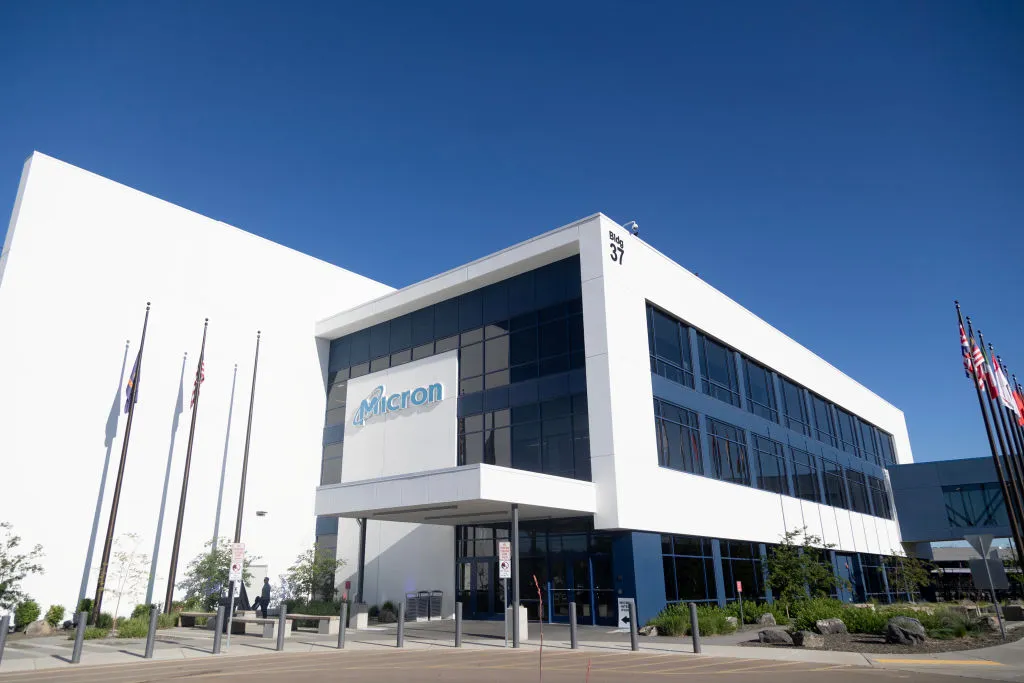
No sector illustrates "sell everything you make at whatever price you want" better than memory chips right now. Micron Technology's (MU) high-bandwidth memory capacity is sold out through the end of the year, and its most recent quarterly revenue came in at $41.5 billion, up 346% from a year ago, with gross margin rocketing to nearly 85% from below 40% a year earlier.
Samsung (SSNLF) and SK Hynix (SKHY), Micron's two biggest global rivals, both expect the broader memory shortage to persist into 2027 or later.
Micron stock has already delivered a legendary run — up nearly 340% in the first half of 2026 alone — before cooling off more than 20% from its all-time high. In a shock that isn't finished, that kind of pullback tends to be the more interesting entry point, not a warning sign.
Nebius Group: The compute landlord

Nebius Group (NBIS) doesn't design chips or train AI models — it rents out the GPU clusters that everyone else needs, in an arrangement Wall Street has started calling a "neocloud."
Revenue in its latest quarter jumped 454% from a year earlier to $582 million, and adjusted profitability turned positive for the first time in the company's history.
Nebius has locked in a five-year infrastructure deal with Meta worth up to $27 billion, and Nvidia itself invested $2 billion directly into the company to help secure priority access to its future capacity.
Management's own description of the business is about as clean a definition of a demand shock as you'll find anywhere in the market: The constraint isn't finding customers, it's building fast enough to keep up with them.
Astera Labs: The traffic controller

As AI server racks pack in more and faster chips, the connections between those chips become their own bottleneck — and that unglamorous problem is Astera Labs' (ALAB) entire business.
Revenue in its latest quarter hit a record $392.4 million, up 104% from a year earlier, beating Wall Street's estimates on both the top and bottom lines. Management guided next-quarter revenue to a range roughly 30% above what analysts were modeling.
Its newest Scorpio X fabric switches only recently entered mass production and are already expected to become the company's largest product line within a quarter of launch.
JPMorgan, Jefferies and Morgan Stanley all raised their price targets by 20% or more immediately after the print. It's also the smallest and most volatile name on this list, so size any position with that in mind.
The risk worth repeating
Every AI stock on this list has already had a big run, and several — Micron, Nebius and GE Vernova among them — trade at valuations that assume the good times keep rolling with no hiccups along the way. That's simply the nature of buying into a demand shock the rest of the market can already see.
The case for owning these names isn't that they're undiscovered; plenty of professional money has already found them. It's that the capital spending behind them — an estimated $31.6 trillion in the next quarter-century, according to PwC — is nowhere near finished, and each new leg of that buildout has so far crowned a fresh winner nobody was talking about 18 months earlier.
Buy in stages rather than all at once, keep position sizes reasonable given the volatility, and remember that a demand shock eventually resolves itself as new supply gets built. The goal is to own these stocks while the imbalance is still working in their favor — not after it's already closed.
Related content
- 10 Major AI Companies You Should Know
- The US Confronts China’s Industrial-Scale AI Theft
- The Best AI and Robotics ETFs to Buy in 2026
- SaaSmageddon Survivors: 5 Top Software Stocks to Buy
