Why Leaving an Equal Inheritance to Your Children Could Backfire
Although equal splits look fair on paper, they can ignore lifetime gifts, different needs or hard-to-divide assets and leave siblings fighting long after you’re gone.


Leaving an equal inheritance sounds fair and like the right thing to do. Just split everything down the middle, avoid playing favorites, and do what you have to do to keep the peace. Easy.
But "equal" doesn't necessarily mean "fair," and even your best intentions can lead to the opposite result: Resentment, tax surprises and shattered relationships after you're gone.
The decision becomes even more important when you consider that over the next two decades, Americans will pass down over $100 trillion in the so-called Great Wealth Transfer.
From just $107.88 $24.99 for Kiplinger Personal Finance
Become a smarter, better informed investor. Subscribe from just $107.88 $24.99, plus get up to 4 Special Issues

Sign up for Kiplinger’s Free Newsletters
Profit and prosper with the best of expert advice on investing, taxes, retirement, personal finance and more - straight to your e-mail.
Profit and prosper with the best of expert advice - straight to your e-mail.
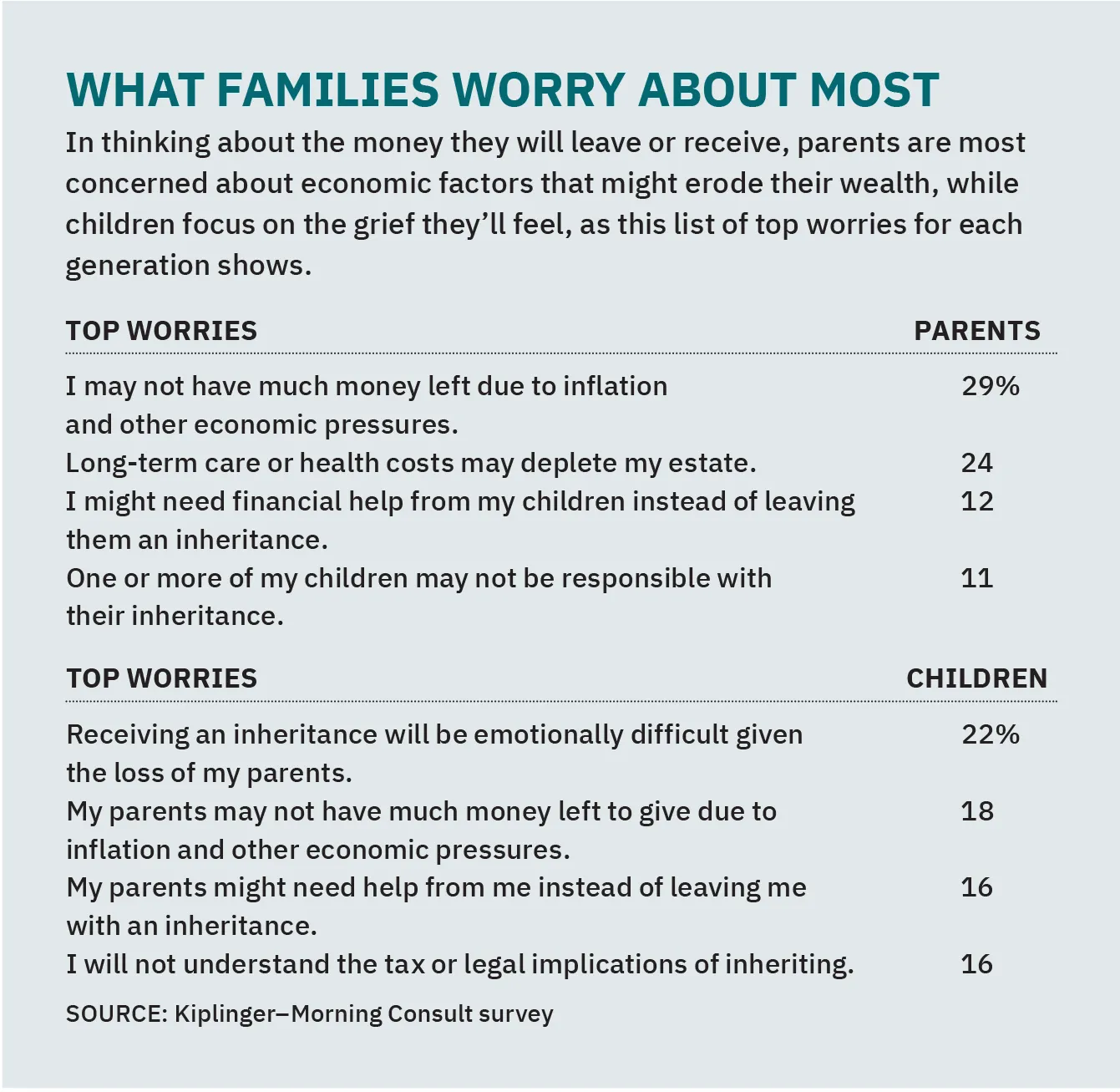
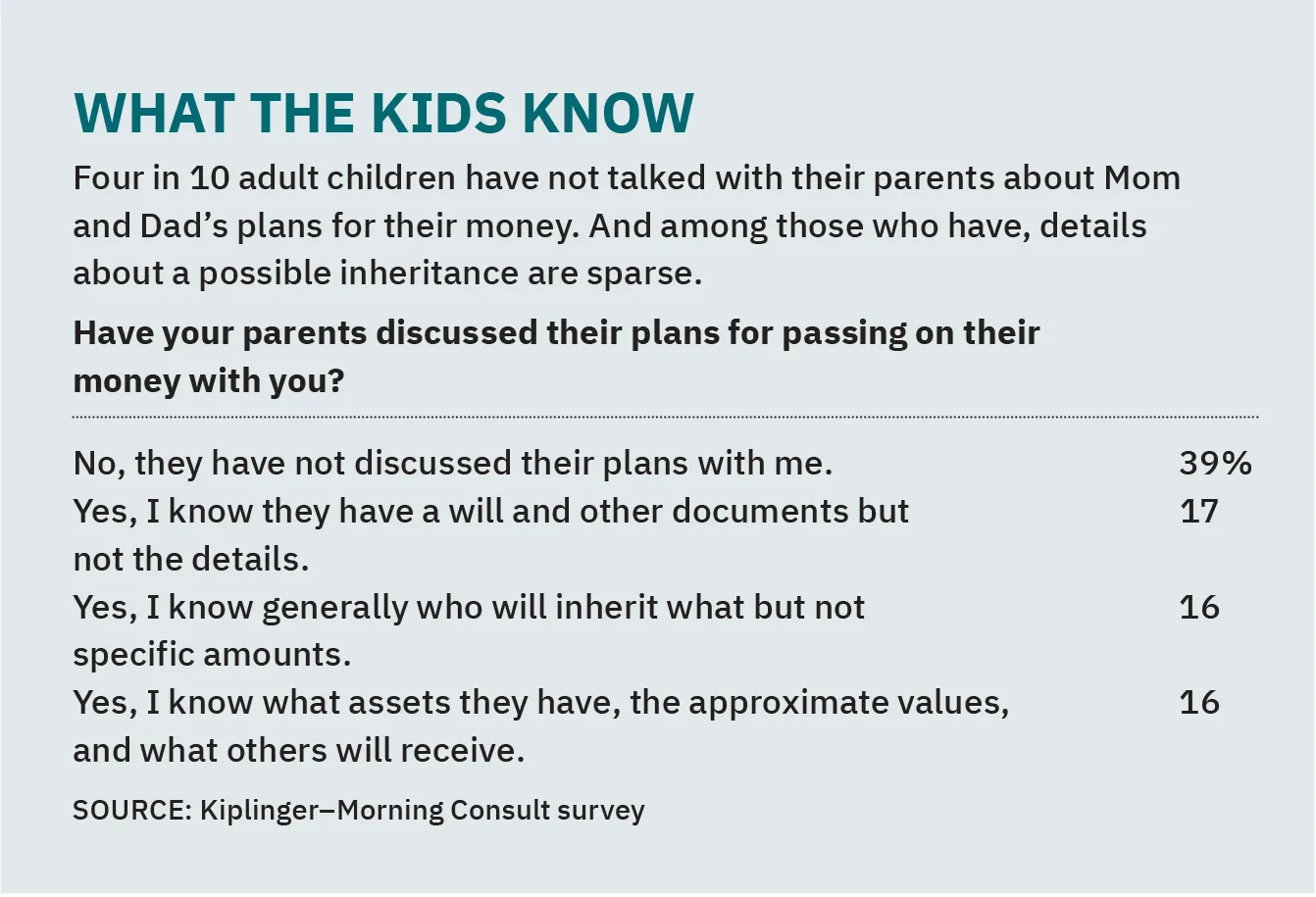
But when it comes to inheritance plans, a new Kiplinger-Morning Consult survey reveals a major gap in expectations and knowledge between older and younger generations in many families. Two in five families have never discussed inheritance plans, and three in 10 parents have no formal plans at all.
Should you leave an equal inheritance to your children? In most cases, the answer is yes, but it can be a double-edged sword, explains Ryan Skinner, president of Apex Retirement Services.
Should fairness be your first concern?
Skinner says the best starting point is to plan to divide the inheritance equally while keeping your options open. "Successful children should not be punished for succeeding, and children who have made poor decisions should not automatically be rewarded for failing."
Phil Reed, estate and asset protection attorney at Reed Law, agrees. "Inevitably, fairness is always the first concern. But fairness and equality are not the same thing, and having simplified math isn't always the best choice when determining the percentage of a distribution."
For instance, "When a child has served as a caregiver for the parent, the parents may want to compensate that child for the years that they were involved with their care and support. Alternatively, a child actively involved in the family business may be entitled to a higher percentage of the estate when other siblings were not involved."
When you have children with different needs and different involvements with the family, equal distribution tends to be inequitable, at least in the minds of the heirs, he says.
"The primary thing to keep in mind when deciding how to divide your estate is communicating the reasons for that decision and having those memorialized in your estate plan specifically."
All is fair in love
The Morning Consult-Kiplinger survey finds most adult children (70%) and parents (67%) feel ready to manage an inheritance. However, readiness isn't always the same as fairness.
For instance, it's common to give one child a down payment on a house or pay their college tuition. Maybe you covered a financial emergency for another child. Unfortunately, the child who received less during your lifetime might feel resentful, while the one who already benefited might not remember your help.
Without a change to your estate plan (sometimes called a hotchpot clause), the equal division can highlight any uneven splits.
Testate and intestacy statutes
Under United States law, a person who creates a valid will can divide their money and property in almost any way they choose. When someone dies without a will, state law distributes their estate based on family ties instead of splitting it equally.
When a will exists, the estate is testate, and the will controls how your property is divided. If you have no will, the estate is intestate, and the state's intestacy statute provides a formula that rarely leaves your kids with the same amount. The idea that siblings automatically get "equal" slices of the same pie is a myth that can cause lawsuits, hurt feelings and tax surprises.
Assets that can't be easily split
Leaving your family home "equally" to your children can lead to months or even years of unwanted maintenance, unpaid taxes and arguments, especially when they can't agree on selling, renting or keeping it.
One sibling often ends up doing all the work while the other siblings wait for the cash to roll in. "Thankfully," says Evan Mills, financial adviser at Scholar Advising, "there are different ways to set up entities so the kids no longer have to worry about who's going to pay for the new roof or the property taxes."
But if that structure isn't available for some families, he goes on to say, a house can become the main area of disagreement within the family, and that's not what you want, especially at what's already going to be an emotional time.
Likewise, a family business split equally among siblings who never worked there can complicate decision-making or force a sale, essentially eliminating the livelihood of the child who runs it.
Reed contends that life insurance proceeds and retirement accounts also look equal on paper but produce different tax results depending on the sibling's tax bracket and says that communication is the single most effective safeguard against discrepancies.
"Explain your reasoning while you're still alive. A letter of intent that accompanies your estate plan documents can reduce the 'Mom loved you more' narrative." Professional trustees, no-contest clauses and updated beneficiary designations on nonprobate assets further reduce the chance that the plan unravels in court," he says.
Sacrifices might go unrewarded
It's not uncommon for one child who becomes the default caregiver — living nearby for years, driving to appointments and managing medications — to feel they deserve a greater inheritance when compared with the sibling who only visited twice a year. This scenario can easily lead to bitterness and resentment.
In the same way, handing your big spender the same lump sum as your penny pincher can often hurt more than help.
Trusts with spendthrift provisions mainly exist because equal gifts can backfire.
Beyond the financial side, the emotional impact is also rarely clear-cut because inheritances are typically viewed as a substitute for parental love. Even wealthy children can experience an equal-but-unexplained estate plan as a form of rejection if their needs or circumstances differ.
When estate lawyer Marvin Blum asked Warren Buffett and the late Charlie Munger about inheritances at the 2022 Berkshire Hathaway annual meeting, Munger replied, "If you're going to treat them unequally, that is poison."
But a "split it equally" plan can cause many of the same problems: lawsuits, claims that Mom and Dad loved you more, or worse yet, siblings who argue and never speak again. Many estate lawyers say that when decisions are left unexplained, families fight, even if the split looks even on paper.
That said, more kids favor "fair" over equal than parents do, by a 21-percentage-point margin, according to the same Kiplinger-Morning Consult survey.
A better approach exists

Brian Gately, managing partner at Anchyra Partners, argues that a better approach exists.
"While the instinct to divide an estate into precise, equal percentages is understandable, rigid equality often fails to account for the unique realities of your children's lives, capabilities and callings."
He says that rather than viewing unequal divisions as favoritism, families should view estate planning as a customized toolkit designed to give each child the specific support they need to thrive.
"By using modern trust structures, you can ensure that your less financially inclined children are protected and your public-service-minded children are supported, all while preserving long-term family harmony."
Closing the inheritance expectation gap
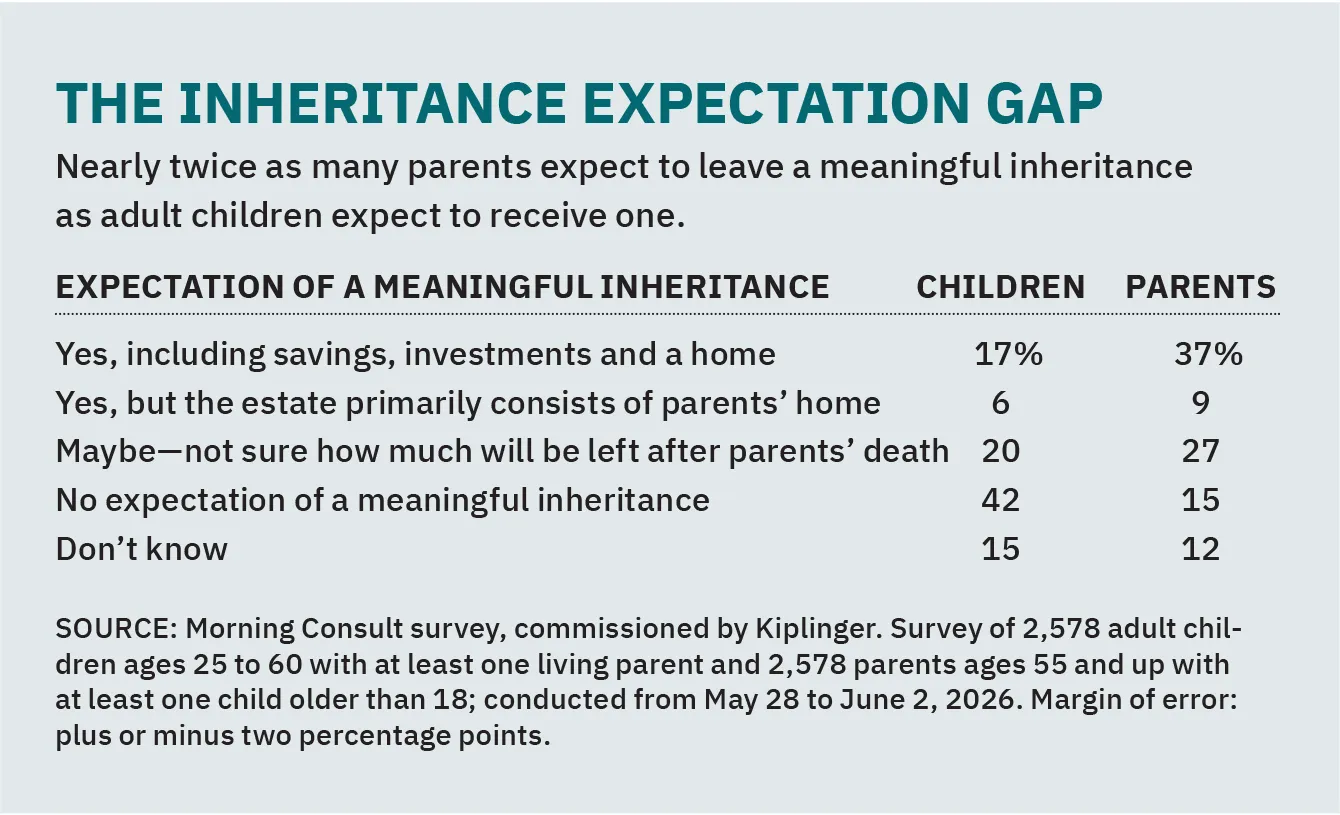
The Kiplinger-Morning Consult survey revealed a stark disconnect: Parents are twice as likely to plan on leaving a meaningful inheritance as adult children are to expect one. Bridging that gap requires open communication and a big-picture view.
You'll need to weigh past financial support, individual sibling needs and the mix of liquid and illiquid assets. Rather than defaulting to an equal split, work with an estate-planning attorney to tailor a strategy that makes practical sense.
Ultimately, an inheritance isn't about picking a favorite child. It's about leaving a legacy that unites your family instead of dividing it.
More Trillion Dollar Talk
- The Trillion Dollar Talk
- We Asked 5,000 Americans About Inheritance. Here's What We Learned.
- What Happens When You Inherit a House — With Your Siblings