We Asked 5,000 Americans About Inheritance and the Great Wealth Transfer. Here's What We Learned
Our exclusive national survey on inheritance reveals how adult children and parents are — and are not — working together to make the most of assets built over a lifetime.


Do you plan to leave your children a meaningful inheritance? Do you worry about how inflation and long-term-care costs might affect how much you have to give? Have you talked to your kids about your plans? Or, if you're the adult child in this equation, have you broached the subject of inheritance with your mom and dad?
On the eve of what's expected to be a historic generational transfer of wealth in the U.S., Kiplinger set out to explore how families are navigating inheritance planning in their households — what they intend, what they hope for, what they worry about and how they've communicated with each other. Toward that end, we partnered with research firm Morning Consult to field a national survey asking 5,156 Americans — half adult children ages 25 to 60, half parents ages 55 and up — to share their views and circumstances.
Here is a look at what we learned.
From just $107.88 $24.99 for Kiplinger Personal Finance
Become a smarter, better informed investor. Subscribe from just $107.88 $24.99, plus get up to 4 Special Issues

Sign up for Kiplinger’s Free Newsletters
Profit and prosper with the best of expert advice on investing, taxes, retirement, personal finance and more - straight to your e-mail.
Profit and prosper with the best of expert advice - straight to your e-mail.
Parents and adult children are not on the same page
When it comes to inheritance plans, the survey reveals a big gap in expectations and knowledge between the older and younger generations in many families.
For starters, adult children are far less likely to think they'll be getting an inheritance at all, compared with parents who expect to leave one. Some 42% of younger respondents say they don't expect to receive a meaningful amount, but just 15% of parents say they won't have any money to pass down. On the flip side, about twice as many parents, in fact, do plan on leaving a meaningful inheritance as adult children who anticipate they'll get one.
The kids generally aren't clear what assets will be involved, either. Nearly two-thirds of parents say they have money in cash and savings, but fewer than four in 10 children think those assets are part of the older generation's estate. Adult children are also far less likely to say that life insurance, real estate, an IRA or a 401(k), and other investments are part of their parent's holdings, compared with parents who say they own these assets.
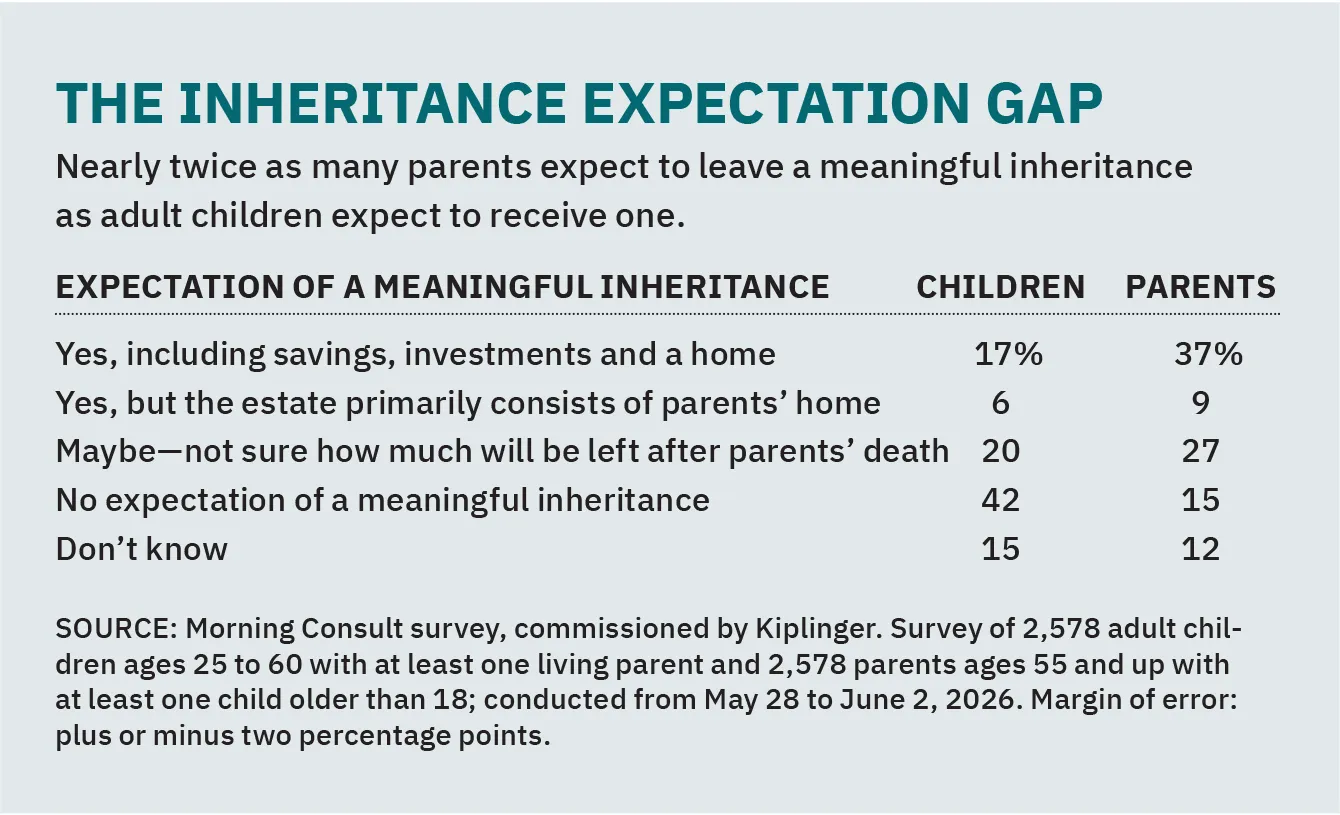
There are also big generational gaps concerning how much financial help parents extend to their children now (parents consistently say they are helping more than children believe); whether it's better to split inheritances evenly among siblings or consider other factors such as financial need or past assistance (more kids favor "fair" over equal than parents, by a 21 percentage point margin); and whether they've discussed an inheritance plan (more parents report having shared information than children recall hearing).
"Both parents and adult children need to do a better job of understanding where the other side is coming from," says Kurt Supe, a certified public accountant and retirement planner at Creative Financial Group in Indianapolis and CFD Investments. "The key is better communication."
There's a gender gap when it comes to inheritances, too.

Sons are more confident about their ability to manage an inheritance than daughters, the survey results show. That's in keeping with other research showing men's greater belief in their financial acumen (although the studies don't necessarily indicate that faith is justified).
Sons are also more likely than daughters to expect an inheritance (30% versus 18%), to say their parents have shared plans for passing down assets, and to know how to locate Mom and Dad's will and other estate-planning documents. Daughters, by contrast, answered "not sure/don't know" to questions more frequently than sons — about how much they'll inherit, whether they'll owe taxes on the bequest, and even whether they prefer financial help from their parents now or a larger inheritance later.
45% of dads have stayed tight-lipped, compared with just 33% of moms.
When it comes to talking to the kids about inheritance plans, moms rule. Although both mothers and fathers express the same comfort level in talking to their children about money, dads in practice are more likely to have said nothing to their kids about their inheritance plans (45% of dads have stayed tight-lipped, compared with just 33% of moms).
Financial adviser Stephanie McCullough, founder of Sofia Financial, a financial planning firm for women in Berwyn, Pa., suggests that women who aren't confident about managing their finances may get past the hump if they connect with a friend they feel comfortable talking with about money or if they consult with a professional. Says McCullough: "Find a money buddy or an adviser to help. And if they make you feel stupid, find a different one."
Everybody has big questions about inheritance
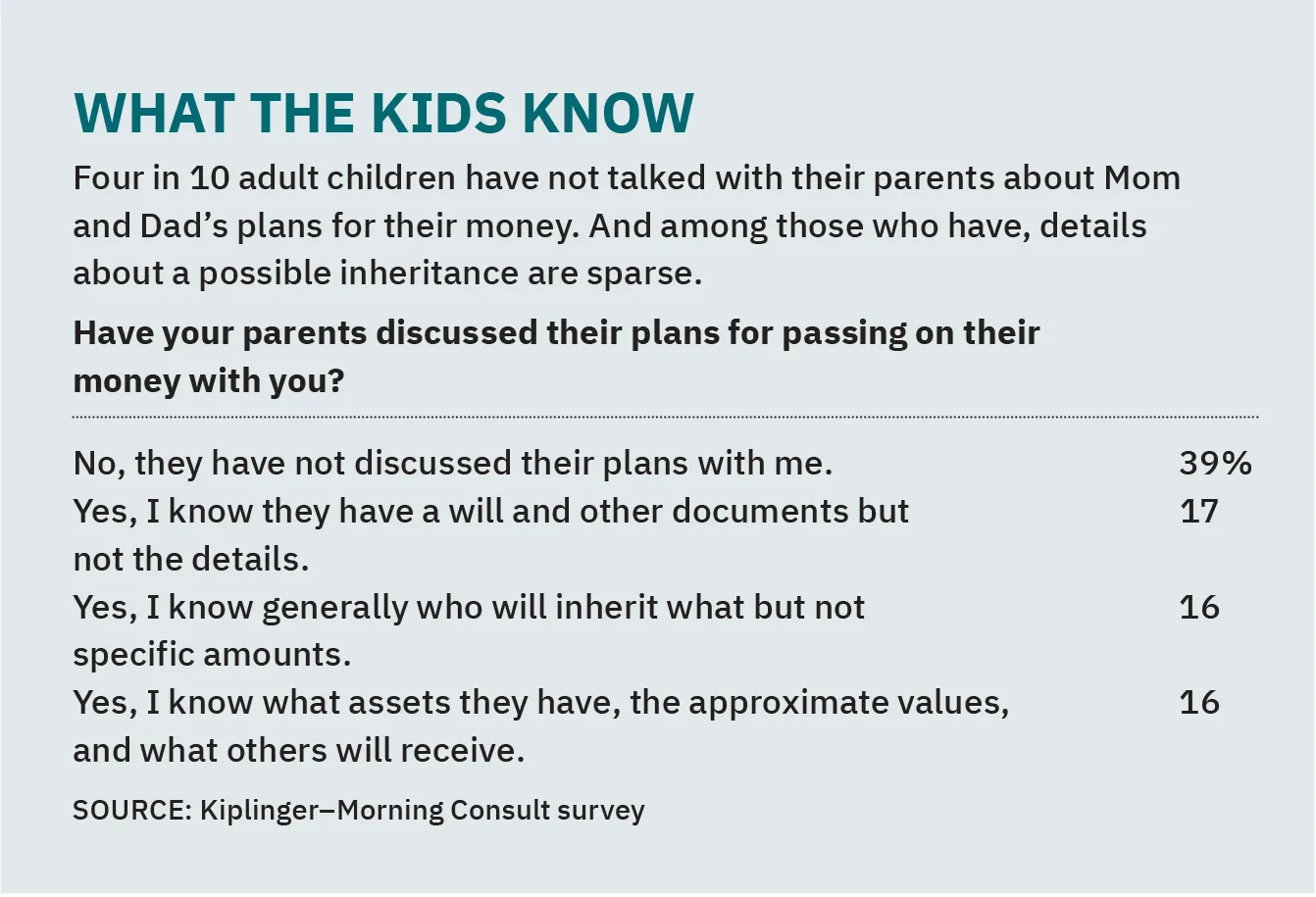
Inheritance plans live largely in the dark, the survey shows. Two in five families have never discussed them, and three in 10 parents have no formal plans. Families rank inheritance next to last among topics they feel comfortable discussing — only sex and dating elicit more of a shudder.
And the less wealth parents have, the quieter things get.
It's not just that parents and kids don't communicate; it's that many don't even know what's at stake. More than one-third of adult children and nearly four in 10 parents aren't sure whether the older generation will have any assets left to pass down; just over one-fourth of parents can't estimate the size of their estate; and 43% of children and 38% of parents have no clue how much each of the kids will inherit.
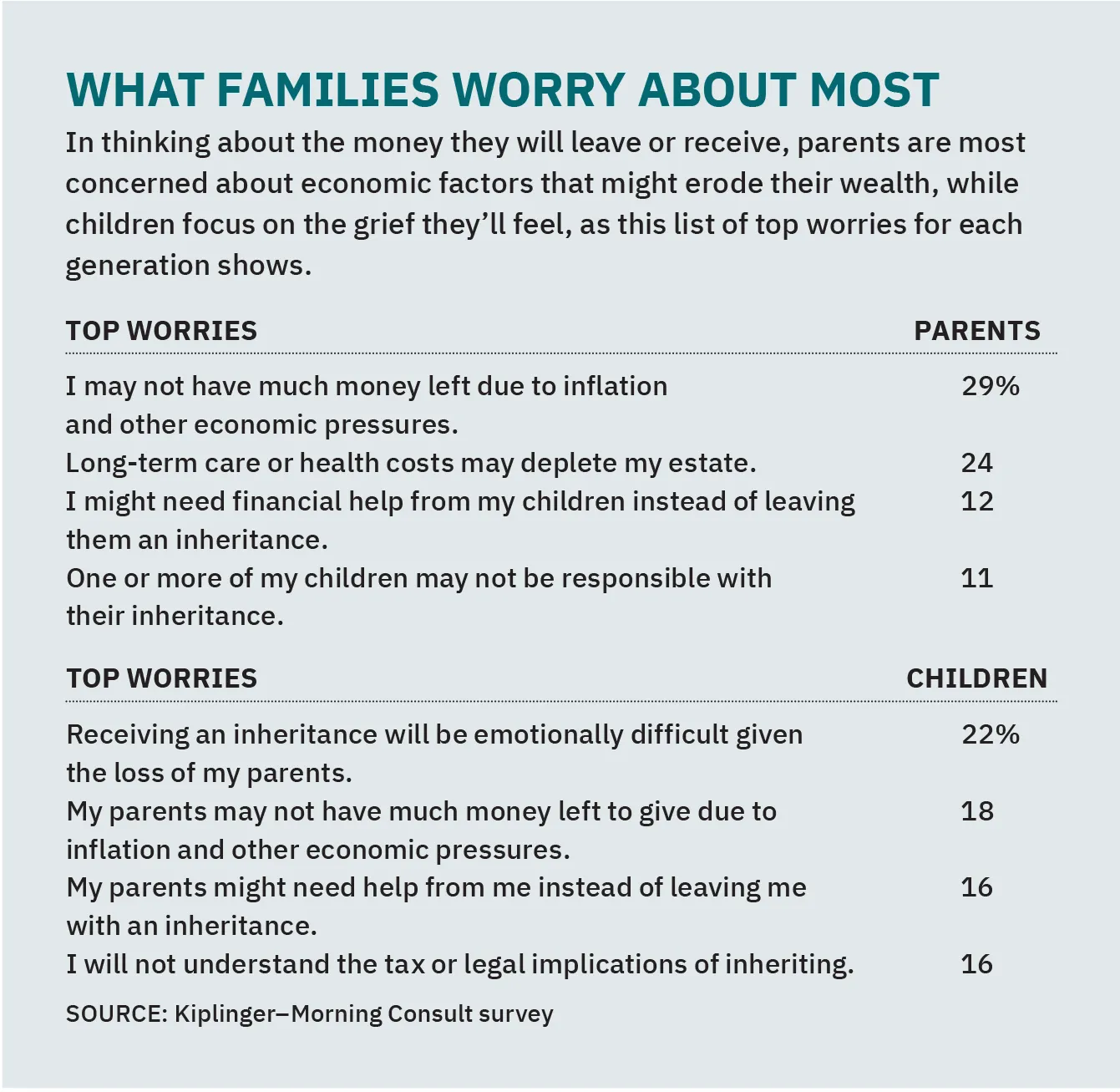
The top reason parents stay silent: "There are too many unknowns about how long I will live or how much will be left." Inflation and other economic pressures top their list of concerns, along with possible long-term-care costs. Kids worry about those things on their parents' behalf, too, and some 16% are also anxious that their moms and dads will need financial help from them instead of the other way around.
Wealthier families — parents with incomes above $100,000 or estates worth $1 million or more — share those same top concerns. But they also keep quiet about estate plans because they do not want their offspring to count on an inheritance (cited by about one in three parents with estates estimated at $500,000 or more, for instance, compared with 19% of parent respondents overall).
That's understandable, says financial psychologist Brad Klontz, who notes, "You don't want your child's financial plan to be your death."
Love and good intentions are abundant
When asked what they'd want done or would do with an inheritance, both parents and adult children focused primarily on practical moves that would help the younger generation. Paying off debt. Buying a home. Saving to build wealth and a secure retirement. Providing a better life for the children of the adult kids and the parents' grandchildren.
Something else families agree on: Most adult children feel ready to manage an inheritance (70%), and nearly as many parents (67%) feel the same.
What would adult children ask their parents, if they felt comfortable? Sure, some (18%) were curious to ask, "How much?" But others wanted to know their parents' wishes for the money so they could respect those intentions (9%), and to understand more about the older generation's experiences (12%). As one adult child put it, "I would ask if they were truly happy in life."
David Chubak, head of wealth management and field management at Edward Jones, says families shouldn't keep questions, feelings and plans about wealth transfer inside. He encourages them to talk in advance of assets changing hands. "These are important conversations that touch every family and every level of wealth," he says. "My best advice is to start now."
Note: This item first appeared in Kiplinger Personal Finance Magazine, a monthly, trustworthy source of advice and guidance. Subscribe to help you make more money and keep more of the money you make here.
More Trillion Dollar Talk
- The Trillion Dollar Talk
- How to Talk to Your Adult Kids About Their Inheritance
- Why So Many Families Are Unprepared for the Great Wealth Transfer — and What You Can Do About It
- An Expert's Guide to the Estate Planning Documents Everyone Needs
