No One Wants to Ask Their Aging Parents About Their Finances, But Here's How
Use these tips to help you open the door to conversations about their financial health before it’s too late.


Asking about your parents' finances can feel awkward until an emergency hits. You've procrastinated for years, but now, here you sit across from your parents at the kitchen table, talking about the grandkids or their last vacation, and a quiet voice in your head starts whispering about the urgency to ask the important questions:
- Do they have enough money or assets set aside if one of them needs long-term care?
- Do they have a will?
- Who has the passwords to their online banking accounts?
- What happens to the house?
But you worry this conversation might sound as if you're angling for an inheritance, so you keep quiet.
That scenario might be especially familiar to Gen Xers, many of whom are watching their parents age while still supporting their own children or planning their own retirement. Relying on an inheritance can be risky, and talking about it still feels taboo.
From just $107.88 $24.99 for Kiplinger Personal Finance
Become a smarter, better informed investor. Subscribe from just $107.88 $24.99, plus get up to 4 Special Issues

Sign up for Kiplinger’s Free Newsletters
Profit and prosper with the best of expert advice on investing, taxes, retirement, personal finance and more - straight to your e-mail.
Profit and prosper with the best of expert advice - straight to your e-mail.
It feels so taboo that only about two in five families have discussed inheritance plans, according to new research from a Morning Consult-Kiplinger survey. Not to mention that families rank inheritance next to last among topics they feel comfortable discussing.
However, Psychology Today advises that talking openly about money can reduce anxiety, strengthen relationships and improve well-being.
Unsure of how to bring up money with your aging parents? Here are a few tips to help you start the conversation.
The trade-offs to waiting to discuss money
Many families treat money as a hands-off topic. That is until a parent's long-term care needs, sickness or financial shortfall forces the issue. But by then, decisions about who pays what, how much support is necessary or what trade-offs are acceptable tend to be reactive rather than planned.
Evan Mills, MBA, associate financial adviser at Scholar Advising, points out that if you wait, you could reach estate limits, so the wealth your parents accumulated over the years doesn't go to the next generation; it goes to the government and the tax bill. "It's also difficult to manage at that point if you don't know the wealth your parents accumulated."
Cameron Huddleston also knows the cost of waiting. The personal-finance journalist (and frequent Kiplinger contributor) was 35 when her mother was diagnosed with Alzheimer's. By the time she tried to unravel her mom's finances, the conversation had become much harder.
She later wrote the book Mom and Dad, We Need to Talk, precisely because she wished someone had pushed her to start earlier. "When there's an emergency, it's a lot harder to have a rational conversation about finances," she said. "Your emotions are all over the place."
The inheritance expectation gap
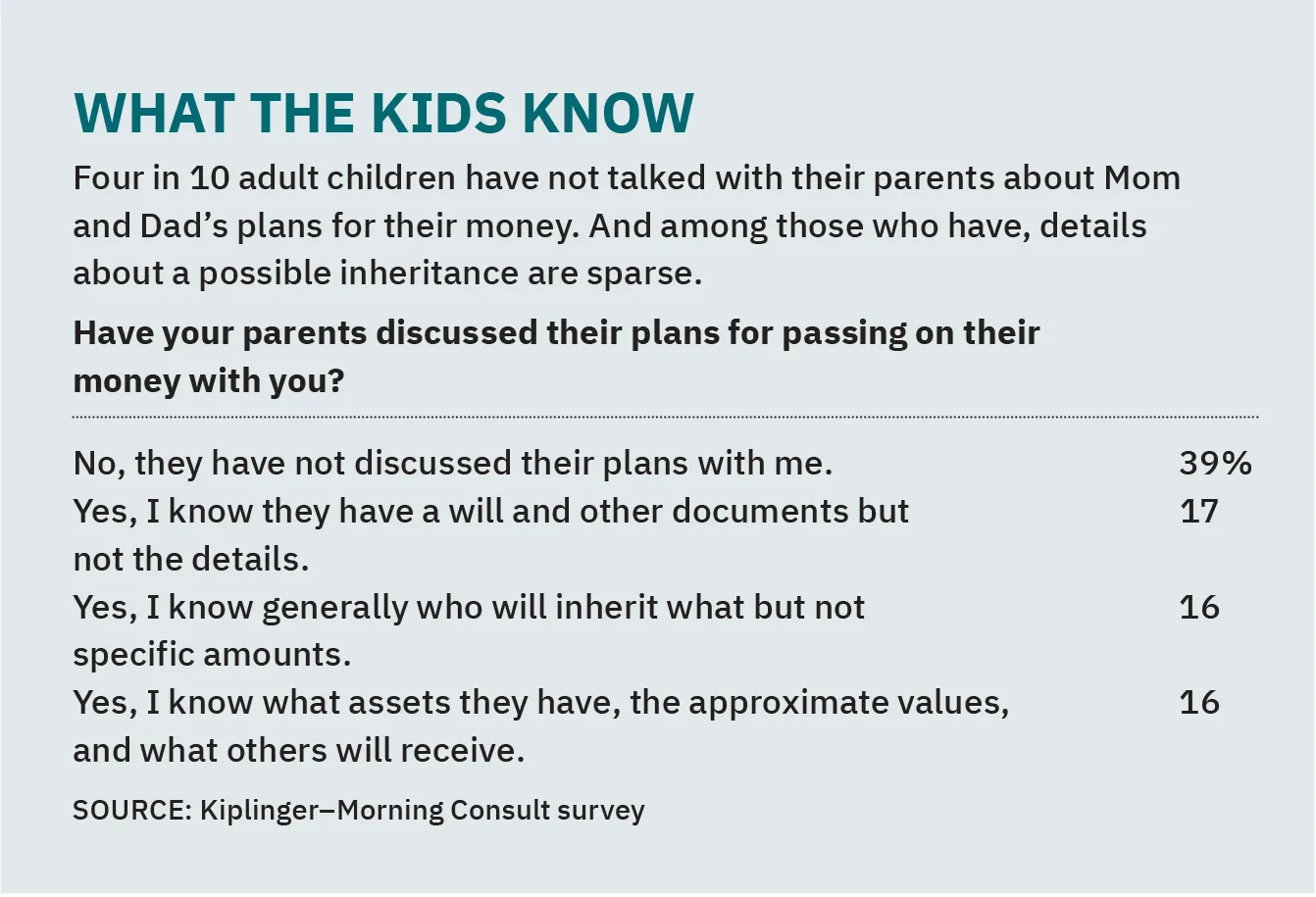
Recent surveys from 2025 and 2026 reveal that conversations about parents' finances remain rare. For instance:
- The Kiplinger-Morning Consult survey points out that 60% of adult children would rather talk to their parents about politics than inheritance, and 80% of parents would rather discuss their physical health than their inheritance plan.
- Among parents age 55 or older with at least $500,000 in investable assets, 68% have not discussed what their children might inherit, and more than half have not shared their net worth. Nearly half of families have still not engaged in estate-planning conversations, according to Fidelity's 2025 Family & Finance Study (PDF).
- Key Wealth's 2026 Inheritance Pulse Poll (PDF) revealed that only 34% of families who expect an inheritance have had a direct family conversation. The rest were operating largely on assumptions. Half of those who had never raised the topic said they avoided it because they didn’t want to appear to be counting on the money.
- Catalyst Advisory's "Family Wealth in America" study found that only 14% of adults had held detailed inheritance discussions, while 36% had never discussed inheritance with their families. Nearly one in four people who expected (or thought they might receive) an inheritance had never talked about it.
How to start a conversation about money with your parents

Parents hesitate to talk about their finances mainly because of uncertainty: 34% cite too many unknowns about how long they'll live or how much will be left, according to the Kiplinger-Morning Consult survey. Another 22% say they haven't gotten around to it. But only 7% say they stay silent because they're uncomfortable discussing money with their children.
Mary Ware, senior wealth adviser and managing partner at Carnegie Private Wealth, says the best way to approach these tough conversations is from a place of preparation, not control. "Don't start by asking, 'How much money do you have?' Start with, 'If something happened and you needed my help, would I know what to do? And what is most important to you?' "
Timing is crucial. Conversations with parents about their finances often work better as a series of short chats than one long talk.
Other ways to kick-start a conversation might include:
- Choose the right time. If possible, pick a time free of distractions. That might mean avoiding holidays and large family dinners that are already chaotic.
- Decide whether to start one-on-one or with your siblings. Sometimes you might feel more comfortable beginning this kind of conversation privately before bringing in the rest of your family. If you have siblings, it can help to get everyone on the same page beforehand so no one feels blindsided or left out.
- Ease in gradually rather than diving straight into the numbers. Lisa McCurdy, founder and managing partner at The Wealth Counselor, advises skipping talk of death and dying when initiating a conversation. Ask, "If it takes 90 days to recover from your procedure, with no one authorized to manage your affairs, what would you be confronted with once you returned home, fully recovered, to your accounts and property?" This frames the conversation around the lack of predictability and the mess that could develop if nobody has been left in charge.
- Have a few follow-up topics ready. If your initial conversation is brief or nonproductive, try asking more direct questions next time, such as where their important estate documents are kept or if they'd like help organizing their paperwork
- Leave the option to return to the conversation later. These talks rarely finish in one sitting. Give everyone space to revisit the topic after a few days or weeks. Consistency over time usually works better than pushing for every detail at once.
What needs to be covered
Carnegie Private Wealth's Ware says her bare minimum is knowing where their key financial and legal documents are stored, which bank, investment and retirement accounts they hold, and how to contact their financial, tax, insurance and legal advisers.
You might also want to ask whether they have an updated will, financial and healthcare powers of attorney, and other appropriate estate-planning documents. Find out what insurance coverage they have, what regular bills need to be paid and how they pay them, and where to find information about pensions, Social Security and other sources of income.
She's also a big believer in organization. "An organized financial life is a gift we can all give our loved ones. Your adult children shouldn't have to become financial detectives during an emergency. Whether your information is kept in a binder, secure digital system or another organized place, make sure the appropriate person knows where it is and how to access it."
Another often-overlooked question is about their long-term care preferences and whether they’ve set aside any insurance or savings to cover them. Roughly 70% of people turning 65 will need some form of long-term care, and the costs can quickly upend retirement savings.
Bring in neutral help if needed
Conversations with parents about their finances often work better as a series of short chats than one long talk.
When conversations stop or emotions run high, a trusted third party can help lower the temperature. Mills says,
"We always joke with clients to just blame the adviser when breaking the ice." When you have a meeting with a financial adviser, he or she might think it's important to add a potential inheritance and what that might look like, into the plan, she said. A well-designed structure can fall apart if nobody really understands the plan.
Joseph Fresard, attorney at Simasko Law, recommends introducing the conversation by bringing up difficulties friends or family members went through who did not have their affairs in order and letting them know you've found an attorney who you think could help get their estate plan done.
A financial planner or estate attorney can reframe the discussion as professional planning rather than a cross-examination. Your parents might want to go over the details with an adviser first before bringing you into the conversation.
Know enough to help your parents protect their future
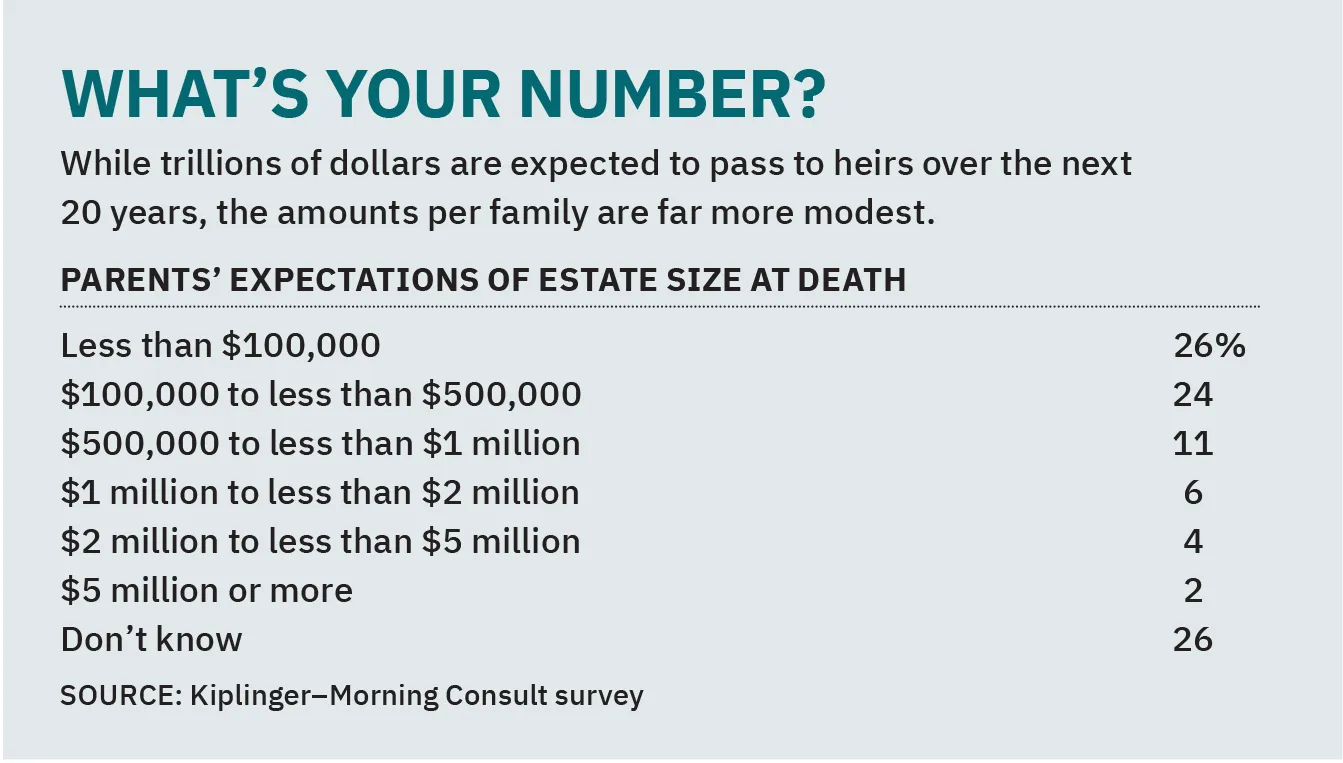
Keep in mind that asking the size of your future inheritance might not be in your best interest at this time. You don't need that exact number to be informed.
What you do need is enough information to help your parents protect their own future and to prepare yourself for what’s to come. Essentially, you're asking for information to help keep them from losing their dignity and their independence, and that's a conversation worth having.
More Trillion Dollar Talk
- The Trillion Dollar Talk
- We Asked 5,000 Americans About Inheritance. Here's What We Learned.
- What Happens When You Inherit a House — With Your Siblings
- 5 Critical Questions to Ask a Financial Adviser About an Inherited Stock Portfolio