7 Reasons Your Portfolio Needs More Than Just an S&P 500 ETF in 2026
An S&P 500 ETF might be the easiest, most obvious investment you can make. But it probably shouldn't be the only one.


"Buy an S&P 500 ETF" is maybe the most ubiquitous advice in the modern investing world. Financial advisers tell you to do it. I tell you to do it. And we even provide descriptions of the best index funds to buy.
For the most part, investors listen. Dozens of ETFs are tethered to the S&P 500 in various ways, but only four directly track the index. And they’re among the most popular funds on the planet:
The iShares Core S&P 500 ETF (IVV) has assets under management of $821.8 billion. The Vanguard S&P 500 ETF (VOO) has $817.5 billion, the State Street SPDR S&P 500 ETF Trust (SPY) $751.5 billion. And the State Street SPDR Portfolio S&P 500 ETF (SPYM) has $140.8 billion.
From just $107.88 $24.99 for Kiplinger Personal Finance
Become a smarter, better informed investor. Subscribe from just $107.88 $24.99, plus get up to 4 Special Issues

Sign up for Kiplinger’s Free Newsletters
Profit and prosper with the best of expert advice on investing, taxes, retirement, personal finance and more - straight to your e-mail.
Profit and prosper with the best of expert advice - straight to your e-mail.
That's right: These four funds collectively command a wild $2.5 trillion in assets. More telling still? IVV, VOO and SPY are the three largest ETFs by assets in the U.S.
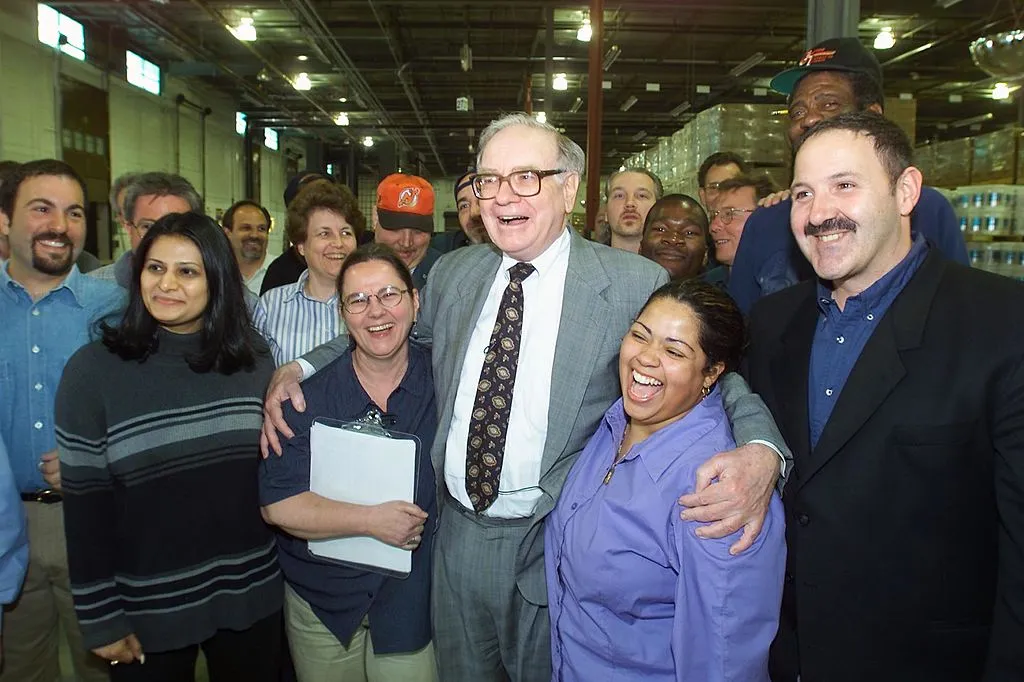
Perhaps the most convincing S&P 500 salesman of all is still none other than Warren Buffett. The erstwhile CEO and still-active chairman of Berkshire Hathaway (BRK.B) has long pounded the table for cheap-index ownership.
"Over the years, I’ve often been asked for investment advice, and in the process of answering I’ve learned a good deal about human behavior," Buffett wrote in Berkshire's 2017 letter to shareholders. "My regular recommendation has been a low-cost S&P 500 index fund."
He said the same thing in an interview that year. He wrote it in his 2013 shareholder letter. He said it during the 2019 annual meeting. Before any of that, in 2007 he openly challenged the whole hedge fund industry, saying an S&P 500 tracker would take down costlier, actively managed hedge funds.
One man, Protégé Partners co-founder Ted Seides, answered the call and took the other side of a $1 million bet. His quintet of hedge funds trailed so badly that he conceded defeat a few months early.
After learning all that, you might ask yourself, "Why would I ever invest in anything but an S&P 500 ETF?"
And I'd answer, "For a lot of reasons, actually."
1. You want to beat the market
The first reason is the worst reason, at least where probability is concerned: You think you can do better. That's what Ted thought. Look what happened to him.
Or look at what routinely happens to people whose stated objective is to beat the S&P 500. From the year-end 2025 S&P Indices Versus Active (SPIVA) report by S&P Dow Jones Indices:
"In our largest and most closely watched comparison, 79% of all active large-cap U.S. equity funds underperformed the S&P 500, worse than the 65% rate observed in 2024 and the fourth-worst year for active large-cap managers over the 25-year history of our SPIVA Scorecards."
That's no fluke. Over the past 10 years, only about 14% of active large-cap funds topped the index. Over the past 15 years, that number dips to 10%.
Other asset classes altogether have had a poor time of it, too. Gold returned less than half of what the S&P 500 did between 1976 and 2025, according to NYU Stern School of Business data. Corporate bonds trailed. Ten-year Treasury bonds trailed. Real estate trailed by a mile.

Did you notice something, though? Most of those assets are considered less risky than large-cap stocks and thus wouldn’t be expected to grind out better yardage (more on that idea in a minute).
However, a more adventurous investment – small-cap stocks – did indeed have "the juice." Stocks in the bottom decile of market cap delivered an average annual return of 8.2% to the S&P 500's 8.0% over that same time period, albeit with far more vicious swings.
As Ted Lasso would've reminded Coach Beard, all people are different people. Your investment goals and hunger for risk aren’t the same as everyone else's.
And that's the central theme to most of the reasons why you might want to own something other than an S&P 500 ETF.
Here? You might want to beat the market and you might have a high risk tolerance as well as decades to make up for any losses.
If so, you can't beat the market by owning only the market. You've got to own something else, too.
2. You don't want that much volatility
One of the reasons why people invest outside of the S&P 500 is because they want their portfolio to have smoother, less volatile returns than what the S&P 500 doles out.
Let's look at standard deviation, which depicts how much the return of an investment has varied from its long-term average over a certain period of time.
The higher the standard deviation, the more volatile the security has been:
Category |
Fund |
Ticker |
Standard deviation |
Real estate |
State Street Real Estate Select Sector SPDR ETF |
XLRE |
17.1 |
Large-cap stocks |
Vanguard S&P 500 ETF |
VOO |
15.3 |
Gold |
SPDR Gold Shares |
GLD |
14.9 |
Large-cap value stocks |
Vanguard Value ETF |
VTV |
14.7 |
Low-volatility large-cap stocks |
Invesco S&P 500 Low Volatility |
SPLV |
12.6 |
Intermediate-term bonds |
iShares Core U.S. Aggregate Bond ETF |
AGG |
5.1 |
Intermediate-term Treasuries |
Vanguard Intermediate-Term Treasury ETF |
VGIT |
4.5 |
Short-term bonds |
iShares 1-3 Year Treasury Bond ETF |
SHY |
1.6 |
Real estate and gold have been volatile, too. But they're not as correlated with stocks. When one zigs, the other sometimes zags. And that can produce lower portfolio volatility.
Most people gradually migrate into less volatile assets over time as they get closer to (and into) retirement, and their focus shifts from wealth accumulation to wealth protection.
People in their 30s, 40s and even 50s have plenty of time to recover from steep bear-market losses. But anyone who's about to be (or already is) living on a fixed income from retirement withdrawals have less tolerance for sudden 20% or 30% drops in their net worth.
Don't feel ashamed if you're young and feel like the S&P 500 is too volatile for you. Some people don't have the stomach for big market dips and can get spooked into poor decisions like liquidating their accounts and stuffing cash under their mattress.
Sometimes it's better to trade sub-market returns for being able to sleep at night.
3. You want more income
In a similar vein, some people are willing to accept a lower potential annual return as long as more of that return comes in the form of dividends or interest income.
While dividends have historically been a significant part of the S&P 500's total return, the lion's share still belongs to price gains. And you're not really getting much in the way of income; the index yields barely more than 1%.
High-yield dividend funds pay closer to 3%. A core bond portfolio? Around 4%. Junk bonds? More than 6%. Will any of those assets return better than the S&P 500 over the long run?
History says no. And even those income percentages aren't guaranteed. Companies can cut or suspend dividends, and interest-rate changes can impact how much a bond fund pays over time.
But those assets deliver a higher percentage of returns that aren't linked to market swings. For many investors, that provides peace of mind.

4. You want to avoid concentration risk
The S&P 500 is made up of 500 companies. Were a fund's assets spread across all 500 companies equally, each company would account for just 0.2%. So a big move in any individual stock wouldn't move the needle much.
Alas, the S&P 500 is market cap-weighted, which means a pure S&P 500 tracker like VOO, IVV and the rest are market cap-weighted. That means the larger the stock, the more the assets invested in each stock.
Nvidia (NVDA) accounts for 8% of assets. Apple (AAPL) is close to 7%. So is Google parent Alphabet (GOOGL).
That means a move in NVDA or AAPL will push an S&P 500 ETF around a heckuva lot more than a move in marginal holdings such as Campbell's (CPB) or News Corp (NWS).
That's also why the S&P 500 is also imbalanced on a sector basis. Tech stocks make up more than a third of assets. Financial stocks account for more than 10%, as do communication services stocks.
But utility stocks, materials stocks and real estate investment trusts (REITs) are each relegated to weights of less than 3%.
There are good arguments that this has helped, not hindered, the index over time.
But it's a risk that some people don't care to take on, enough so that the Invesco S&P 500 Equal Weight ETF (RSP), which lets you own those stocks in even portions, has amassed nearly $90 billion in assets.
A specific edge case? People who work for big publicly traded tech firms and have a lot of compensation in stock don't want additional exposure to the sector, let alone their own companies.
That's less a solution for equal-weight funds, however, and more of a job for direct indexing.
5. You want more diversification
Much like you might not want to be overweight in a single stock lest that stock struggle and hold back your returns, many advisors preach diversification across different stock sizes and styles, and even different assets, to prevent the same thing in case U.S. large caps stall out.
Consider target-date funds (TDFs), which are designed to give us the investment exposure we need throughout our lives.
TDFs don't own just the S&P 500 or some other U.S. large-cap portfolio. They usually also own some mid-cap stocks and small caps, as well as international stocks, and even domestic and foreign bonds. Sometimes they'll even own commodities and/or real estate.
6. An S&P 500 mutual fund might be cheaper (in two ways!)
The reason why most people would tell you to buy an S&P 500 ETF, and not an S&P 500 mutual fund, is because of fees.
In fund investing, if all else is equal – and when it comes to S&P 500 trackers, it is – you should buy the fund with the lowest fees, which will net you the highest return. And that's not always going to be an S&P 500 ETF.
Right now, SPYM is the cheapest S&P 500 ETF at 0.02% annually. But the Fidelity 500 Index Fund (FXAIX) charges 0.015%. If your advisor offers access to the Vanguard 500 Index Fund Institutional Select Shares (VFFSX), that share class charges just 0.01%.
But a few mutual funds are also cheaper on a nominal basis. Mutual funds often require you to invest a certain dollar amount on your first purchase, like $1,000 or $3,000. That would normally give SPYM, at around $86 per share, an advantage.
But FXAIX, as well as the Schwab S&P 500 Index Fund (SWPPX, 0.02% expense ratio), let you start buying for as little as $1. So if you're starting out with little money, at least a couple S&P 500 mutual funds are an easier lift than any S&P 500 ETF.
By the way, when Warren Buffett made his bet, he didn't use an ETF. He used the Vanguard 500 Index Fund Admiral Shares (VFIAX), which was one of the most cost-efficient ways to buy the index at the time.

7. Warren himself wouldn't bet the whole farm on the index
When it comes to the serious matter of providing for his wife after his death, the Oracle of Omaha says he's putting his money where his mouth is.
He is … but not all of it. From Buffett's 2013 letter to Berkshire shareholders (emphasis mine):
"What I advise here is essentially identical to certain instructions I’ve laid out in my will. One bequest provides that cash will be delivered to a trustee for my wife’s benefit. … My advice to the trustee could not be more simple: Put 10% of the cash in short-term government bonds and 90% in a very low-cost S&P 500 index fund. (I suggest Vanguard’s.)"
If even the great S&P 500 champion found room in his will for an additional investment … chances are you'll find one, too.
As of this writing, Kyle Woodley owned shares of SPYM … but also a bunch of other investments.
Related content
- 5 Core Stocks Every Investor Should Own in 2026 and Beyond
- 5 ETFs to Hedge Your Inflation Risk
- Best Dividend ETFs to Buy Now