Dow Falls 631 Points After Fed Hikes Rates: Stock Market Today
Stocks were mixed but steady until Fed Chair Kevin Warsh started talking about today's rate hike and what comes next.

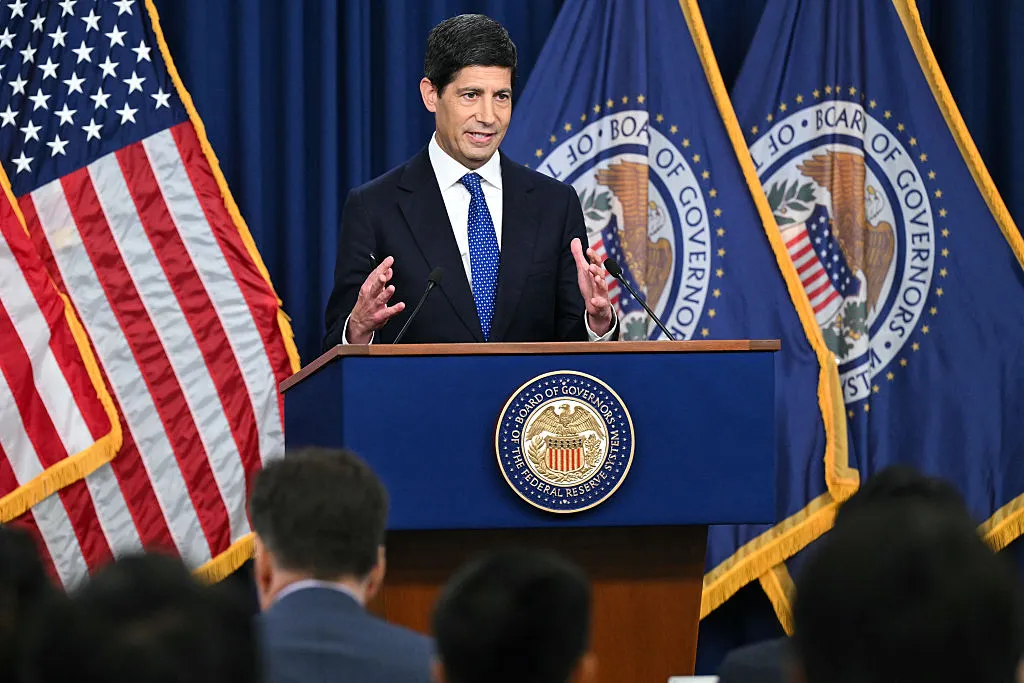
The main stock indexes turned lower after the Federal Open Market Committee (FOMC) raised interest rates by 25 basis points on Wednesday. Following the central bank's first rate hike in three years, Fed Chair Kevin Warsh said that a unanimous decision underscores the FOMC's commitment to price stability.
In another brief statement, the FOMC said economic expansion is solid, but uncertainty is elevated due in part to geopolitical developments. At the same time, domestic spending is resilient, productivity is strong and capex is robust.
During his post-meeting press conference, Warsh said that conditions consistent with full employment give the Fed plenty of room to focus on price stability. As the FOMC stated, "Inflation remains elevated."
From just $107.88 $24.99 for Kiplinger Personal Finance
Become a smarter, better informed investor. Subscribe from just $107.88 $24.99, plus get up to 4 Special Issues

Sign up for Kiplinger’s Free Newsletters
Profit and prosper with the best of expert advice on investing, taxes, retirement, personal finance and more - straight to your e-mail.
Profit and prosper with the best of expert advice - straight to your e-mail.
As Warsh reiterated after sidestepping a question about President Donald Trump's potential reaction to a rate hike, "I said we will deliver stable prices. Today's decision is consistent with that."
The target range for the federal funds rate is now 3.75% to 4.00%. The FOMC's quarterly Summary of Economic Projections (PDF) shows members expect to make one more rate hike this year.
At the closing bell, the tech-heavy Nasdaq Composite had slipped 0.01% to 25,978, the broad-based S&P 500 was down 0.5% at 7,551, and the blue-chip Dow Jones Industrial Average had shed 1.2% to 51,461.
Looking for more timely stock market news to help gauge the health of your portfolio? Sign up for Closing Bell, our free newsletter that's delivered straight to your inbox at the close of each trading day.
"Historically," LPL Financial Chief Technical Strategist Adam Turnquist observes, "following a rate hike that ended a pause of six months or longer, the S&P 500 gained an average of 5.5% over the subsequent 12 months."
That's happened 12 times since 1972. The average maximum drawdown during that period was 9.4%.
"Although the future path of monetary policy remains uncertain," Turnquist concludes, "history suggests that a transition from a prolonged pause to renewed tightening has not necessarily derailed equity markets."
Follow along with all the latest news and updates on our September Fed meeting live blog.
Crude retreats, yields are volatile, retail sales rise
The front-month West Texas Intermediate crude oil futures contract declined by 3.7% to $101.94 per barrel on Wednesday amid reports of easing pressures on supply from the Middle East and a smaller-than-expected U.S. crude inventory drawdown.
After retreating early, yields across the maturity spectrum surged late and ended mixed. The 2-year Treasury yield was up 7.1 basis points to 4.734%, hitting another new 52-week high. The 10-year Treasury yield (2.0 bps, 5.016% ) also resumed its ascent, but the 30-year Treasury yield ticked down to 5.356% from 5.363% on Tuesday.
Ahead of the opening bell, the Census Bureau said that retail sales were up 1.2% in August after a revised 0.5% decline in July, exceeding a consensus forecast of 0.7%. Core retail sales expanded by 1.4%, the fastest pace since September 2024.
"Although this report is very positive for economic growth," writes Raymond James Chief Economist Eugenio J. Alemán, Ph.D, "it may raise further eyebrows for those conducting monetary policy, as the strength in consumption could put further pressure on inflation going forward."
OpenAI wants to be a trillion-dollar company
According to the Financial Times and The Wall Street Journal, OpenAI is talking to potential investors about a new capital-raising round that would value the ChatGPT maker at more than $1.2 trillion.
OpenAI raised $122 billion in March at a valuation of $852 billion. Investors in that round included Amazon (AMZN, -1.0%), Nvidia (NVDA, +0.8%) and SoftBank, who combined to contribute $110 billion.
Management said OpenAI surpassed 1 billion active users since its previous funding round. Second-quarter revenue grew to $6.7 billion from $5.7 billion in the first quarter, though operating margin compressed.
Meanwhile, CEO Sam Altman told Fortune that OpenAI will delay its much-anticipated initial public offering (IPO).
"Given everything happening with safety," Altman explained, "right now would be an ill-advised moment to go public, and we don't feel pressure on that."
JBHT cuts guidance because of higher fuel costs
J.B. Hunt (JBHT, -13.3%) was the worst-performing S&P 500 stock on Wednesday after Chief Financial Officer Brad Delco said higher diesel fuel costs will drive a sharp sequential decline in the trucking company's third-quarter earnings.
As Al Root of Barron's notes, J.B. Hunt doesn't usually offer top- and bottom-line guidance.
"We want to be transparent with investors and give an update that, in light of these costs that are sort of hitting us, we are expecting our Q2 to Q3 earnings to actually drop 5% to 10%. Sorry to give you a range," Delco said in a presentation at a Morgan Stanley (MS, -1.8%) conference.
The CFO of the industrial stock cited "a little bit of a mismatch, based upon the delay part of pricing, that we see in intermodal relative to the costs we're feeling now." Delco added that J.B. Hunt is seeing "some of the most radical and abnormal swings in fuel prices" ever.
According to AAA, the national average diesel price hit its highest level on record today at $6.3103. That's up 70.5% from $3.7008 a year ago.
Related content
- How to Invest for Fall Rate Hikes by the Fed
- Stock Picks That Billionaires Love
- The Hidden Costs of Inheriting an Investment Portfolio