Is $3.2 Million Enough to Retire in an Expensive College Town?
College towns are booming retirement hubs, but experts warn that retirees often underestimate the hidden costs of returning to campus. We break down the options for a couple with $3.2 million.


As retirement approaches, you may be considering a move to a college or university town. Whether you want to retire near your old alma mater or are considering a different college town, you know the allure. These areas often have a high quality of life, with good walkability, attractive architecture, great restaurants and of course, access to a vibrant community.
Buying a home in a college town you love could work out well if you can swing it based on current property values. Your analysis will need to go beyond home values, however, as property taxes, access to healthcare and other considerations may prove just as important.
Here's how a financial professional and a couple of real estate experts suggest you approach the decision. We include a case study of a couple with a $3.2 million portfolio.
From just $107.88 $24.99 for Kiplinger Personal Finance
Become a smarter, better informed investor. Subscribe from just $107.88 $24.99, plus get up to 4 Special Issues

Sign up for Kiplinger’s Free Newsletters
Profit and prosper with the best of expert advice on investing, taxes, retirement, personal finance and more - straight to your e-mail.
Profit and prosper with the best of expert advice - straight to your e-mail.
"College towns represent one of the most stable residential markets in the country." — Cody Schuiteboer
A home in a college town could be a great investment
The first retirement home you buy isn't guaranteed to be your forever home for that stage of life. You may decide that after a decade or so, you're tired of the bustle of a college town and would rather settle somewhere else. So it's important to make sure you're buying a home that can hold its value, especially if it's on the expensive side.
Blaz Korosec, licensed Realtor and founder/CFO of the real estate solutions company Investorade, says that generally speaking, homes in college towns tend to be smart investments.
"College town real estate appreciates or at least maintains value better than your standard market due to institutional employment influencing housing demand," he says.
As Korosec explains, universities typically employ thousands of faculty and staff. And students perpetually need housing, too.
"Even when the rest of your regional economy sputters, dormitories stay filled and the local university employer keeps raising wages," he says.
Cody Schuiteboer is the president and CEO of mortgage firm Best Interest Financial, and he agrees that, from a property-value standpoint, college towns are a strong bet.
"College towns represent one of the most stable residential markets in the country," he says.
And while you may be wondering whether high turnover could affect home price appreciation, Schuiteboer says that's not much of a concern.
"Students tend to concentrate heavily only in blocks closest to campus itself, typically within a three- to five-block radius, where increased noise, heavier demand for parking space, and accelerated wear can create problems for owners," he explains. "Other than that, college town markets tend to function in a very similar fashion to any other established residential market, with the added benefit of a university economic anchor in place."
That said, colleges commonly own large amounts of tax-exempt land. This often forces municipalities to levy significantly higher property taxes on residential homeowners to fund public services, which may mean your ownership costs are high.
Plus, if the value of your home is tied to a nearby college that ends up closing, your property value could fall. That may not be a huge problem if you don't want to sell it, but it's something to be aware of.
We break down the numbers for a $3.2 million nest egg
Let's run the numbers for an imaginary couple in their 60s, Jenny and Adam. They met as students at the University of Michigan in Ann Arbor in the 1980s and have a $3.2 million nest egg. They want to retire near the University. With that amount of savings, they certainly have decent purchasing power. But whether the numbers work depends on Ann Arbor's home prices and their personal priorities.
"A $3.2M portfolio may support drastically different standards of living in different towns," Schuiteboer says. "What makes this decision work is largely a factor of choosing the right college town in terms of property tax rate and cost of owning and maintaining the property there, among other things."
Schuiteboer also cautions that it's important to factor in maintenance and homeowners insurance when running your numbers. And, he says, be prepared for property taxes to be on the higher side.
"Retirees frequently underestimate the costs involved in owning and maintaining a home in an expensive college town, primarily due to the fact that the property tax rates there are significantly higher than elsewhere," he says.
Jim DesRocher, Founder at TrueView Financial, also cautions that while $3.2 million is a strong starting point, "your balance is not your paycheck."
"At a sustainable 3% to 3.5% withdrawal rate, that portfolio produces roughly $96,000 to $112,000 per year before taxes," says DesRocher. "If you're moving to a high-cost area with property taxes of $15,000 to $25,000 per year plus elevated homeowner costs, you've consumed a significant share of that income before you've bought a single grocery."
The average home price in Ann Arbor, MI, for example, is $531,674, according to Zillow, which puts estimated property taxes for a typical Ann Arbor home at $7,922. But if we apply that same 1.49% tax rate to a $1 million Ann Arbor home, that's an annual property tax bill of $14,900, which could strain a portfolio producing $96,000 to $112,000 per year.
The good news is that some states are implementing property tax relief programs, including senior or homestead exemptions. That's something to look into if tax rates are high in the college town you're looking at.
As for maintenance, the rule of thumb is to set aside between 1% and 4% of your home's value per year. Older homes should lean more toward that upper number, but for the sake of our example, let's say that Adam and Jenny need to spend about 2% per year on maintenance. Here's how the numbers add up.
Annual home expenses other than mortgage and insurance |
Average home price $531,674 |
$1 million home |
|---|---|---|
Property taxes |
$7,922 |
$14,900 |
Maintenance (2%) |
$10,633 |
$20,000 |
Total expenses |
$18,555 |
$34,900 |
Total annual investment income remaining, before income tax |
$93,445 |
$77,100 |
All told, Schuiteboer says, "The real question for this particular scenario is not whether the couple can afford the move, but whether their housing costs in the college town allow them the kind of retirement they really want to have."
As you conduct your own research, make sure to calculate the total cost of ownership and determine how much leeway it provides for your remaining expenses. If it'll mean skimping on travel and other experiences, it may not be worth it. But if you can swing a home in a town that holds a special place in your heart, you may be able to spend at least part of your retirement basking in nostalgia and enjoying a vibrant town that helps you stay young at heart.
College towns can be a great fit for retirees
It's true that college towns may cost more, both in home prices and property taxes, but they offer benefits that can lead to a healthier, happier retirement. For example, many colleges provide free or near-free college classes for seniors.
If you are an alumnus, you may also get free or reduced access to campus athletic facilities, concerts and even dining spaces. For example, Middlebury College alumni may receive an ID card that provides access to the athletic center and library, as well as discounted access to the school's Ralph Myhre golf course. Stanford offers a concierge service for alumnae seeking long-term care insurance,
Search online for your college name and "alumni benefits" to learn what may be available for you.
The healthcare paradox
Many college towns, such as Ann Arbor, Michigan, benefit from university research hospitals and cutting-edge specialists. While that means retirees may be able to access excellent care, there are some potential downsides to keep in mind.
First, wait times to see a specialist may be long because patients are attracted to the high-quality care. And given that the area population skews younger, there may not be as many geriatric specialists. Moreover, college towns in more rural areas often face a shortage of medical providers. For example, Cornell University is located in Tompkins County, New York, where a 2026 assessment found chronically long wait times and provider shortages.
Finally, retirees on Medicare Advantage plans, which may limit your choice of providers, may have difficulty finding a primary care physician (PCP) in their network, or one that is accepting new patients.
One solution is to see a network of doctors in the nearest metro city. For example, if you live in Northampton, Massachusetts (near Smith College, Amherst and UMass Amherst), you may elect to travel to Boston for medical appointments.
Will all those college students create noise and traffic?
When you think back on your college days, you may remember bustling weekends filled with sporting events and packed bars and restaurants at night. As a 21-year-old, that may be the epitome of fun. As 60-something retirees, the bustle of college town life could get old.
However, Korosec says it may not be a big problem.
"If you're thinking college towns equal crazy Saturdays during the football season and graduation, you’re only right for six to 10 days of the year," he says.
Korosec says you should anticipate congestion on weekends with home games. But for the remainder of the year, you might enjoy relative peace and quiet.
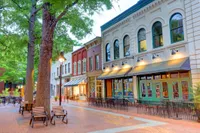
Schuiteboer feels similarly.
"There will always be days in college towns during which traffic will be particularly heavy," he says. But if you know which days to hunker down or perhaps take a trip out of town (think home games, move-in week, and graduation weekend), it probably won't impact your quality of life.
Since it's conceivably been a while since you've lived in the area, if you want to be really sure, Korosec says, "Take a stroll through potential neighborhoods on a Tuesday in October and Saturday during football season and see if you’d enjoy living there before making a decision."
Read More
- 5 Charming Small Towns Where America's Wealthy Retire
- Is a University Retirement Community for You?
- We're 62 and Plan to Sell Our $1.2 Million House to Retire, but Our Daughter and Grandkids Live With Us. My Wife Says We Should Stay. I'm Ready to Ask Them to Move.
- We're 62 With $1.4 Million. I Want to Sell Our Beach House to Retire Now, But My Wife Wants to Keep It and Work Until 70.