What Tech Leaders Have Said About an AI Bubble
Are tech leaders worried about an AI bubble? Here are some of their most notable comments related to bubbles, spending and risk.


To help you understand the trends surrounding business and technology and what we expect to happen in the future, our highly experienced Kiplinger Letter team will keep you abreast of the latest developments and forecasts. (Get a free issue of The Kiplinger Letter or subscribe.) You'll get all the latest news first by subscribing, but we will publish many (but not all) of the forecasts a few days afterward online. Here's the latest…
There’s no shortage of comments from tech leaders about the transformative potential of artificial intelligence. But with AI spending surpassing the level of previous major infrastructure projects, including railroads, electricity and the internet, it’s become more important to consider how the biggest spenders understand the AI buildout.
Here’s what tech executives have said about the risks in interviews, panels, earnings calls and shareholder letters. (Some quotes have been lightly edited for concision and readability.)
On the risk of a bubble
"I think there is a real underlying risk. Whenever there’s uncertainty, there’s a risk of overextension. We all face it..." Dario Amodei
Dario Amodei
Dario Amodei, CEO of Anthropic: "I think there is a real underlying risk. Whenever there’s uncertainty, there’s a risk of overextension. We all face it. I face it. All the other companies face it. There’s an inherent risk when the timing of the economic value is uncertain. There’s an inherent risk of underreacting or overextension. And because companies are competing with each other and, frankly, we genuinely need to compete with, you know, our authoritarian adversaries, there’s kind of a lot of pressure to push things." (12/3/25)
From just $107.88 $24.99 for Kiplinger Personal Finance
Become a smarter, better informed investor. Subscribe from just $107.88 $24.99, plus get up to 4 Special Issues

Sign up for Kiplinger’s Free Newsletters
Profit and prosper with the best of expert advice on investing, taxes, retirement, personal finance and more - straight to your e-mail.
Profit and prosper with the best of expert advice - straight to your e-mail.
Andy Jassy, CEO of Amazon: "Every customer experience will be reinvented by AI, and there will be a slew of new experiences only possible because of AI. I’ve followed the public debate on whether this technology is over-hyped, whether we’re in 'a bubble,' and if the margins and [return on invested capital] will be appealing. My strong conviction, at least for Amazon, is that the answers are no, no, and yes." (4/9/26)
Satya Nadella, CEO of Microsoft: "For this not to be a bubble, by definition it requires that the benefits of this are much more evenly spread. I think a telltale sign of if it’s a bubble would be if all we’re talking about are the tech firms. If all we talk about is what’s happening to the technology, then that’s just purely supply-side. Ultimately, if we’re not talking about, ‘Wow, here is a drug that was sort of brought into the market that’s super successful because it was AI accelerated in the clinical trial.’ And by the way, it’s happening." (1/20/26)
Mark Zuckerberg, CEO of Meta: "I think basically if you look at most other major infrastructure build-ups in history, whether it's railroads or fiber for the internet, in the dot-com bubble, these things were all chasing something that ended up being fundamentally very valuable. In most cases, it ended up being even more valuable than the people who were pushing the bubble thought it was going to be. But in at least all of these past cases, the infrastructure gets built out, people take on too much debt, and then you hit some blip, whether it's some macroeconomic thing or maybe you just have like a couple of years where the demand for the product doesn't quite materialize. And then a lot of the companies end up going out of business." (9/18/25)
Sam Altman, CEO of OpenAI: "I'm not worried about our compute buildout plans. I am worried about the world's compute buildout plans. I think we are going to be able to use all of the compute very profitably that we are planning to build. But I am seeing the first signs of what feels to me like unsustainable silliness of random, new neocloud popping up, people claiming that they're going to build gigantic amounts of compute next year that I think they don't have the revenue to support or a buyer. Yeah, I definitely feel like some fear of what the world is doing as a whole. Although I think we feel very good about what we've committed to." (9/1/26)
Jeff Bezos, founder and executive chairman of Amazon: "This is a kind of industrial bubble, as opposed to financial bubbles. And I'll tell you what I mean by that. If you go back, like the '90s had a biotech bubble and there were a bunch of pharma start-up companies that were designing drugs and using new techniques and the world got very excited. The investment world got very excited. As a group, they all lost money. But we did get a couple of life-saving drugs." (11/3/25)
Bill Gates, founder of Microsoft: "We need to define bubble. If what we mean is like Tulips in the Netherlands, that they eventually looked back and said, 'What the heck? There was nothing there. Those were just tulips.' No, that’s not where we are. If you mean it’s like the internet bubble where in the end something very profound happened, the world was very different. Some companies succeeded, but a lot of companies were kind of 'me, too,' fell behind, burning capital. Absolutely, there are a ton of these investments that will be dead ends." (11/28/25)
On massive AI spending

Sundar Pichai, CEO of Alphabet: "The one way I think about it is when you go through a curve like this, the risk of underinvesting is dramatically greater than the risk of overinvesting for us here. Even in scenarios where it turns out we are overinvesting, these are infrastructure projects that are widely useful for us, they have long useful lives, and we can apply it across and we can work through that." (7/23/24)
Andy Jassy: "We have customer commitments that make our capex investments predictable. We’re not investing approximately $200 billion in capex in 2026 on a hunch. We are willing to make large capex investments and endure short-term [free cash flow] headwinds for the substantial medium- to long-term FCF surplus. AI is a once-in-a-lifetime opportunity where the current growth is unprecedented and the future growth even bigger." (4/9/26)
"If we end up misspending a couple of hundred billion dollars, I think that that is going to be very unfortunate, obviously." Mark Zuckerberg
Mark Zuckerberg
Mark Zuckerberg: "If we end up misspending a couple of hundred billion dollars, I think that that is going to be very unfortunate, obviously. But what I'd say is I actually think the risk is higher on the other side. If you build too slowly, and then superintelligence is possible in three years, but you built it out assuming it would be there in five years, then you’re just out of position on what I think is going to be the most important technology that enables the most new products and innovation and value creation in history." (9/18/25)
Dario Amodei: "I think there’s a real dilemma deriving from uncertainty in how quickly the economic value is going to grow and the lag times on building the data centers that drives this. So I think there’s genuine uncertainty. There’s a genuine dilemma, which we as a company try to manage as responsibly as we can. And then I think there are some players who, you know, who are YOLO-ing, who pull the risk dial too far and I’m very concerned." (12/3/25)
Sam Altman: "In terms of being able to confidently pay for the compute we are committed to, I feel good about that. I think people right now are kind of in a, 'cost is no object, we’re just going to build out crazy amounts of compute, somebody will pay me a higher price.' And if we are able to succeed with our efforts to hugely drive down the cost of compute and the efficiency of compute up a lot, then, you know, you can imagine a world where there are some people that made dumb financial decisions. That happens in kind of like every boom, or most of them." (9/1/26)
On potential fallout
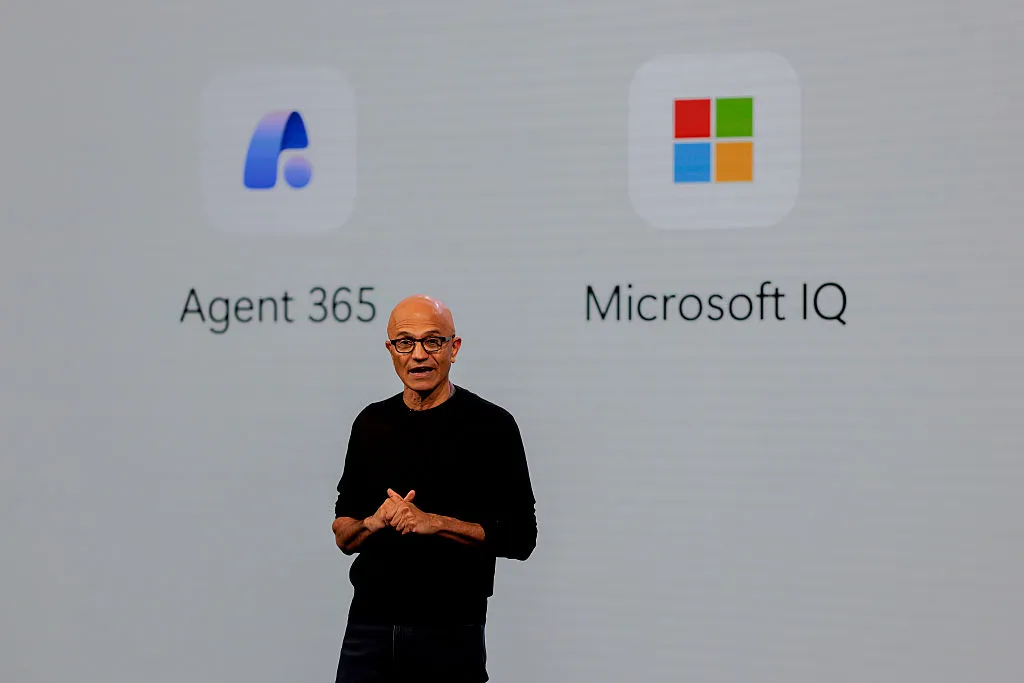
Satya Nadella: "This is a new general-purpose technology that is going to drive productivity and that productivity has to translate into very broad-based economic growth that is economy-wide, in terms of GDP growth. And if we don’t see that, then we are going to have a problem. Unless we see that broad economic growth, then we’re not going to have this movie end well. We are in the early innings of it, but there are real proof points of that." (7/26/26)
Mark Zuckerberg: "There are compelling arguments for why AI could be an outlier [versus previous bubbles]. And basically just if the models keep on growing in capability year over year and demand keeps growing, then maybe there is no collapse or something. But I do think that there’s definitely a possibility, at least empirically, based on past large infrastructure buildouts and how they led to bubbles, that something like that would happen here." (9/18/25)
"If you want to be a tech company, you don't get to say, let's check out of this race." Bill Gates
Bill Gates
Dario Amodei: "Building the data centers has a long lag time. It’s like a year or two. So I have to decide now, literally now or, in some cases a few months ago, how much compute I need to buy in, you know, early 2024 to serve the models in early 2027 when I get to that revenue amount. And there are two coupled dangers. One is that if I don’t buy enough compute, I won’t be able to serve all the customers I want. I’ll have to turn them away and send them to my competitors. If I buy too much compute, of course, I might not get enough revenue to pay for that compute. And, you know, in the extreme case, there’s kind of the risk of going bankrupt." (12/3/25)
Jeff Bezos: "When people get very excited, as they are today about artificial intelligence, for example, every experiment gets funded. Every company gets funded. The good ideas and the bad ideas. And investors have a hard time in the middle of this excitement, distinguishing between the good ideas and the bad ideas. And so that's also probably happening today. But it doesn't mean that anything that's happening isn't real. Like AI is real and it is going to change every industry. In fact, it's a very unusual technology in that regard, in that it's a horizontal enabling layer." (11/3/25)
Bill Gates: "You have a frenzy and you know some of these companies will be glad they spent all this money. Some of them, you know, will commit to data centers whose electricity is too expensive, that it could be done overseas. Or they'll buy a generation of chips and they won't have captured all their value before the next one comes along. But if you want to be a tech company, you don't get to say no, let's check out of this race." (11/28/25)
Sundar Pichai: Alphabet Q2 earnings call (July 23, 2024)
Andy Jassy: Amazon 2025 Letter to Shareholders (April 9, 2026)
Mark Zuckerberg: Access podcast with Alex Heath, "Mark Zuckerberg on the AI bubble and Meta's new display glasses" (September 18, 2025)
Satya Nadella: "Conversation with Satya Nadella, CEO of Microsoft | World Economic Forum Annual Meeting" (January 20, 2026)
CNN, "On GPS: Exclusive interview with Microsoft CEO Satya Nadella" (July 26, 2026)
Dario Amodei: New York Times DealBook Summit, "Anthropic CEO: Massive A.I. Spending Could Haunt Some Companies" (December 3, 2025)
Sam Altman: Sources Podcast with Alex Heath, "Sam Altman on Astra, AGI, and the future of OpenAI" (September 1, 2026)
Jeff Bezos: Reuters, "Jeff Bezos speaks at Italian Tech Week 2025" (October 3, 2025)
Bill Gates: CNBC, "Bill Gates: AI is the biggest technical thing ever in my lifetime" (October 28, 2025)
This forecast first appeared in The Kiplinger Letter, which has been running since 1923 and is a collection of concise weekly forecasts on business and economic trends, as well as what to expect from Washington, to help you understand what’s coming up to make the most of your investments and your money. Subscribe to The Kiplinger Letter.
Related Content
- Anthropic to Seek $2 Trillion IPO Valuation
- The AI Bubble May Burst: 5 Ways Retirees Can Protect Their Portfolios
- How to Spot a Bubble in Stocks