Practical Economics
Where the Economy Is Headed
Stronger business spending and rising employment will help this recovery shake off worries about Europe.
By Richard DeKaser, Contributing Economist, The Kiplinger Letter
June 11, 2010
- Comments
- Email This Article
- Print This Article
- Order a Reprint
Advertisement
Since the U.S. economy pulled out of a tailspin a year ago, upward propulsion has been modest, with tentative employment growth. Now, with Europe teetering on the edge of a financial abyss, worries about contagion are driving down stock prices and sending investors scurrying to U.S. Treasuries. Rumblings about the prospect of a double-dip recession are resurfacing.
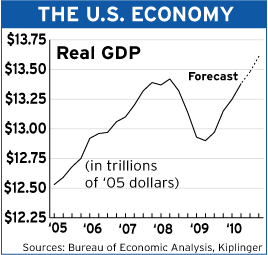
We think a relapse into recession isn’t likely. Odds are that worries about Europe’s woes infecting the U.S. will recede by year-end as policymakers there do whatever it takes in the short term to prevent a meltdown. Indeed, U.S. GDP will grow about 3.5% this year and the same next. Though that’s far from the 6.3% average growth racked up in postrecession periods since World War II, it’s a decent gain and better than the U.S. saw in the last two recoveries, in 1991 and 2002.
Several factors will help drive the growth: Lean inventories, as businesses, which underestimated the rebound, are forced to restock factory bins and store shelves. Business spending on equipment and software -- fueled by rising profit margins, technology innovations, easing credit and business’s huge cash reserves. The continuation of the federal stimulus package this year, though it scales back sharply in 2011 and will detract from GDP growth then.
In addition, there’ll be a pickup in employment and income. Extraordinary productivity gains over the past year have let firms expand output with minimal hiring. But that path will peter out, and employers will have to add to payrolls to lift production even more. Meanwhile, workers who have jobs are bringing home paychecks that stretch farther. Real hourly wages -- measured after wringing out the effect of a big energy price drop -- have climbed 3.5% since 2007. With inflation likely to remain tame, the erosion in real wages that usually comes with high unemployment will continue to be offset. Rock-bottom interest rates won’t hurt either. With the Federal Reserve more worried about deflation than the opposite, it will keep interest rates at record lows into next year.
![]()
Moreover, consumer confidence is on the rise. The most recent University of Michigan monthly reading of 75.5 is nearly halfway between the prerecession mark of 97 and the dismal 55 it hit during the financial crisis. And American’s household net worth is up -- $3.5 trillion from a year ago and $5.8 trillion from its recessionary bottom. Even after accounting for recent market corrections, the S&P 500 is up about 60% from its early 2009 low.
But regaining the robust economic health of a few years ago is still far off, as our new online Economic Health Tracker indicates. For Americans to feel as well off as they did just a few years ago, a variety of other problems must be solved.
Most importantly, there are too many idled resources: Assembly lines operating at less than full speed. Vacant warehouses, factories and storefronts. Mines, utilities and other operations churning out less than before the recession hit. In mid-2009, slightly more than two-thirds of total U.S. industrial capacity was in use. Today, utilization is about 74%, about five percentage points lower than the usual rate when the economy’s thriving, and well below the even higher prerecession rate. And it’s not just manufacturers with spare capacity. Service industries are awash with it as well: Unused equipment at commercial laundries. Lawyers taking pro bono cases to fill their time. Empty chairs at hair and nail salons. And so on.
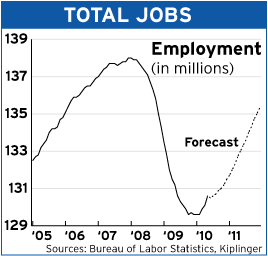
Millions of people remain out of work. The 980,000 net increase in jobs so far this year only begins to chip away at the 8.4 million jobs lost during the 2008-09 rout. Until more employers are confident the economic recovery is on solid ground, they’ll resist committing to permanent hires. As a result, it will take until late 2012 to recover the lost jobs. Worse, because the labor force is always growing -- with young people seeking first jobs plus immigrants -- the jobless rate won’t sink to a more normal 5.5% again until 2014 or so.
![]()
Credit availability also remains far from normal, crimping the ability of private businesses -- especially small firms, which typically account for half of all jobs in the U.S. -- to grow. Under normal conditions, the difference between the share of small companies that say loans are becoming harder to get and the share that say the opposite is no more than about nine points. Today, the difference is 13 percentage points. Tightfisted lenders will eventually loosen up, probably easing standards in the second half of 2010. But for now, huge losses during the Great Recession, uncertainty about financial reform legislation and doubts about the durability of the recovery will restrict credit.
And housing woes need to ease, both because home prices color consumers’ perceptions of their financial well-being, affecting their willingness to spend, and because housing and related industries typically account for 7% of the economy. Making headway when building and sales are stumbling is tough.
The sad fact is, it will take a decade to regain the prerecession highs in construction and sales of new homes. Ditto, home prices, at least in areas that were hardest hit, such as Calif., Fla. and Ariz. That’s mostly because those peaks were artificially high, pumped up by unsound mortgages destined to crumble. It would take three years of annual increases of 3%, followed by three more years of 5% annual gains, for the median home price to match the October 2005 peak.
Indeed, even a return to pre-bubble levels will take years. At 650,000 this year and an expected 900,000 in 2011, housing starts are a long way from 2001’s 1.6 million. New-home sales won’t top half a million until next year and won’t hit 800,000 -- the high end of the normal band in the 1980s and 1990s -- until 2014 or 2015. A slightly less dismal outlook for sales of existing homes: 5.3 million this year and 5.5 million next -- near pre-bubble levels.
Tags:
- Comments
- RSS
Permission to post your comment is assumed when you submit it. The name you provide will be used to identify your post, and NOT your e-mail address. We reserve the right to excerpt or edit any posted comments for clarity, appropriateness, civility, and relevance to the topic.
View our full privacy policy


Reader Comments (11)
Posted by: Daniel at 06/12/2010 09:17:06 AM
You people were wrong about your "expert" predictions about the housing market bubble impact. You were wrong about your "expert" predictions regarding the length or impact of the recession. Your "experts" were wrong about predicting unemployment. C'mon, people! Stop trying to act like the all-seeing oracles on CNBC. You can't predict the future; no one can. Why do you print articles like this? This isn't investment advising; this is pure speculation, and it's irresponsible.
Posted by: Chris at 06/14/2010 11:56:55 AM
I agree with the previous reader. Who is Mr. Kaser? and why does Kiplinger continue to allow him to contribute to your site?...This is the same guy who was encouraging everyone to go out and buy homes in a previous writing...
Posted by: Patrick at 06/14/2010 12:53:29 PM
Mr. DeKaser, another self deluded economist, living in a "pseudo intellectual" world. No clue as to what is really happening out here in the real world. As a small business owner I can tell you that almost all of your "prediction/assumptions" are off base. None of them take into account the devastating effects our country's debt and deficit will (yes..."will" )..have over the next decade. Higher taxes, cuts in benefits will rip the wheels off of any strong recovery. Also not taken into consideration are the effects of extreme government involvement in key industries. But don't feel too bad Mr. DeKaser, an incorrect economist is about as common as a snowy day in Alaska. It's just fun to watch all of that intellect and self confidence go down in flames time and time again.
Posted by: hs at 06/14/2010 01:09:39 PM
One line in the article is particularly bothersome "But regaining the robust economic health of a few years ago is still far off". There are several references in the article about what needs to be done to return our economy back to how it was just a few years ago. But I thought all that growth was essentially faked, with Wall Street basically funding a real estate boom that never should have happened by using money which didn't exist that was leveraged by homes that were over-valued. And the author is looking to return to that kind of economy? Isn't that something we should be avoiding? If you take the rest of the article, it kind of sounds like we should just be growing at a steady, if not spectacular rate. Isn't that a good thing? He kind of sounds like he misses "the good old days" when people spent money they didn't have. I thought it would be better if we just grew at a steady and sustainable pace, and people just spent what they could afford. He makes that sound bad.
Posted by: Stefan Lasiewski at 06/14/2010 01:53:19 PM
@Daniel:...Kiplinger never said the recession would be a short one. In fact, they said that the economy would be in the slumps for more then a year after the recession ended. They said that good growth wouldn't return until late-2010 or 2011. Kiplinger has taken a middle-of-the road outlook on the economy-- no doomsday news, no rosy pictures about the short term economic situation. The writers at Kiplinger offer their opinions and predictions of the future. This is clearly an opinion, based on some facts and evidence. The opinions can be wrong. I don't think anyone claimed that Kiplingers was an oracle, except you. The future belongs to optimists.
Posted by: Kal at 06/14/2010 04:50:41 PM
This article is pure speculation and overlooks many factors such as government debt, personal debt, the aging population and the massive entitlements. Until the government debt is under control (which will never happen until there are term limits and the politician can see beyond the current election), this country will be purely reactionary and will suffer through one crisis after another as Washington repeats the same mistakes over and over again.
Posted by: John11 at 06/14/2010 05:03:00 PM
Two comments: 1. My clients who have made it so far have done so with technological advances. Their increase in productivity, given a slow recovery, will result in little hiring as the jobs lost have been repleaced by computer directed manufacturing equipment. One client had 180 (employees) in one factory prior to 2008, and now has 52. He projects that to produce the same number of product as he did in 2008, he will need at most 58 employees. 2. Since it is in the best interest of banks to keep credit tight and to ignore the number of borrowers who are late in their house payments, the inventory of houses available as bank foreclosure sales should increase. I have clients, who by their own choice, have not made a payment on their mortgage in over 12 months, and who are not in foreclosure. Eventually they will be and they will have room to negotiate. The predictions made by Mr. DeKaser follow typical macro economist theory and he cannot be faulted. Most economists, including myself, have been slow to understand that the paradigm has changed with the current administration. The answers to the economic woes require new approaches, such as changing the accounting rules so that banks can properly reflect true losses in their reporting without the threat of being labeled a bad bank with the risk of takeover.
Posted by: Robert at 06/14/2010 08:15:24 PM
I agree with the previous poster that hoping for a return to the "good old days" is a dangerous pipe-dream. I do, however, agree with the article that there are too many idle resources and unemployed and under-employed in America. This sad fact was overlooked during the bubble years but is now apparent as a result of globalization and off-shore profit chasing. China, for example, has been exporting its unemployment to the US for at least three decades. If we can ever manage to re-establish a level playing field in regard to domestic taxation and international trade, we can return to higher growth rates.
Posted by: Daniel at 06/14/2010 08:54:49 PM
@Stefan- Actually, if you will read the several other posters' comments on this article, you will find that their sentiments echo mine. This is not the first time Kiplinger's has made reccommendations or predictions that were not only incorrect, they were totally off base. I was reading Kiplinger's magazine when the great recession first reared it's head back in 2007; and several of it's "expert contributors" all swore blind that we would be out of the woods by the end of 2009. So I stand by what I said. BTW- The Future, contrary to your opinion, does not belong to the optimist......it belongs to the realist.
Posted by: Paul at 06/15/2010 10:50:12 AM
The 2 questions to ask are- 1 How does Kiplinger make its money? By selling ADVERTISING. 2 Do Multi billion dollar Corps. want to pay to advertize where the headlines read "The Economy is Going to Hell- Save Your Money or "Everything is Great Please Spend and Buy Buy Buy
Posted by: norman at 06/16/2010 06:05:26 PM
Listen Up My Friends! Why don't you look to an expert that will have to take it on the chin if his/her predictions are off based. A good example of that is Stephen Harper, Canada's Leader (he's an economist) who along with his Finance Minister Jim Flaherty have to date very successfully pulled Canada out of this bad depression. They've got some good ideas to offer how to make this work for you as well.
