What Is Gold's True Role in Your Portfolio? An Asset Allocator's Take
To decide whether gold is right for you, consider three roles it could play: As a return driver, as a diversifier or as a hedge.

When it comes to asset allocation, advisers and allocators typically agree on the portfolio building blocks, particularly as it relates to traditional asset classes.
Domestic large-cap and small-cap equities, international equity, fixed income and cash all play well-understood roles.
While there's a limitless mix of potential implementation options to create a portfolio (active, passive, concentrated, qualitative, quant-driven, thematic ...), when you look through portfolios with similar risk levels, you end up with more directional similarities than you might expect.
From just $107.88 $24.99 for Kiplinger Personal Finance
Become a smarter, better informed investor. Subscribe from just $107.88 $24.99, plus get up to 4 Special Issues

Sign up for Kiplinger’s Free Newsletters
Profit and prosper with the best of expert advice on investing, taxes, retirement, personal finance and more - straight to your e-mail.
Profit and prosper with the best of expert advice - straight to your e-mail.
Then there is gold. There's no convergence and no consensus range.
Gold has been a medium of exchange for thousands of years, going back to roughly 600 BC when the Lydians in modern-day Turkey minted the first standardized gold coins.
Yet it's still more likely to be excluded from portfolios. A 2024 Coalition Greenwich/World Gold Council survey found only about 15% of institutional investors hold any gold, and those that do average roughly 4%.
Retail investors are similar: Gallup puts direct physical gold ownership among Americans at around 11%.
Among those who don't believe gold has a role in a portfolio is author, finance media personality, and radio/podcast host Dave Ramsey. He argues that gold doesn't generate income, has a "lousy long-term track record" relative to equity mutual funds, and since the dollar is no longer gold-backed, doesn't offer the inflation protection many assume.
At the other end of the spectrum is Morgan Stanley CIO Michael Wilson. In late 2025, he proposed a "60/20/20" portfolio model: 60% equities, 20% short-duration bonds and 20% gold, effectively replacing half the traditional bond sleeve. His rationale? Bonds have lost some of their safe-haven status and gold is the "antifragile" asset to own rather than Treasuries.
Supporting this view is that central banks, according to World Gold Council data, have gone from net sellers to net buyers of gold since 2010. Ray Dalio, who built Bridgewater Associates into the world's largest hedge fund at its peak, is also a gold advocate.
He recently called for a combined 15% allocation to gold and Bitcoin, describing the two together as "effective diversifiers" against fiat currency devaluation, while noting he personally favors gold over Bitcoin within that mix.
If well-respected investment professionals have varying opinions about gold, what should an investor do? A useful exercise is to explore the three roles gold could play in a portfolio as a return driver, diversifier, or hedge, and allocate according to your view on gold's ability to fill any of these roles.
Option No. 1: Driving a return
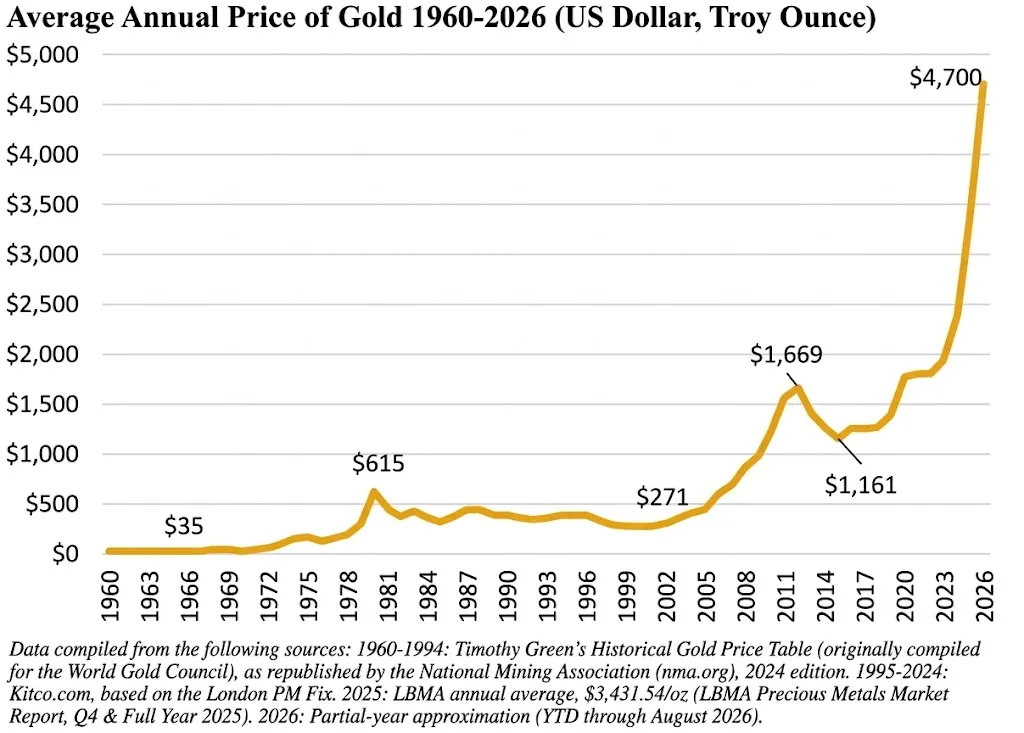
As a return driver, gold faces some challenges consistent with Ramsey's view: it has no yield, no earnings and a history that shows its nominal peak price in January 1980 wasn't reclaimed for nearly 28 years, until 2008, according to the London Bullion Market Association (LBMA) and World Gold Council price data. This extended price drought is shown in the graph below.
That said, recent performance has been robust: the SPDR Gold Shares (GLD) ETF is up roughly 125% in the past three years as of August 13.
Whether gold continues to display strong returns is somewhat dependent on demand for the precious metal. Will central banks keep buying at their current pace, and will gold gain more traction with institutional and retail investors? Investors need to assess how likely that combination is, as without it, the return driver case for gold is weakened.
Option No. 2: Diversifying a portfolio
As for gold's role as a diversifier, the correlation of gold (proxied by the GLD ETF) was analyzed relative to the S&P 500 (SPY) and Russell 2000 (IWM) over the past 20 years ending August 13, 2026. The results found GLD had a correlation of 0.06 (essentially none) to the U.S. large-cap and small-cap markets.
During this period, GLD produced an annualized return of roughly 9.8%, outperforming the IWM's return of 9.2% while underperforming SPY's 11.5% return.
If you back out the strong performance in the past three years, the diversifier case still holds, as GLD returned a respectable 6.3% return for the first 17 years.
It's also important to be reminded that being a diversifier isn't enough on its own. Starting in 1980, gold spent almost 30 years delivering close to nothing, which would have made even a perfectly uncorrelated position a drag rather than a benefit.
Option 3: Acting as a hedge
An interesting potential role for gold is as a hedge, though not against inflation directly, since gold's effectiveness hinges on whether real rates are rising or falling and on how aggressively policymakers respond. The better framing is a hedge against the dollar itself, or what is often called debasement risk.
In practice, virtually all institutional and retail portfolio planning processes embed an assumption that the dollar remains stable. A faltering or collapsing dollar might be considered an unlikely event, but so were the global financial crisis and COVID. Should investors spend more time thinking about the risk associated with fiat currencies? Consider the following, based on Treasury Department and Congressional Budget Office (CBO) data:
- The gross federal debt has grown from $5.7 trillion in 2000 to roughly $40 trillion today.
- Debt per capita has risen from about $20,000 to more than $112,000 in the same period, with no deceleration in sight.
- The CBO's most recent long-term outlook projects gross federal debt climbing from roughly 123% of gross domestic product (GDP) today to 190% by 2056.
- Interest on the debt is estimated at 14% of outlays and 19% of revenue in 2026, based on CBO-sourced estimates.
- These figures exclude the estimated $88 trillion present value of unfunded Social Security and Medicare obligations, per the Treasury Department's own Financial Report of the U.S. Government.
The growing deficit is not a prediction that the dollar will falter — it's a reason to think about what happens to a portfolio if it does.
Fixed income offers little protection in that scenario, since a currency crisis and rising rates tend to move together. Equities, priced and discounted in dollars, would likely struggle as well.
In this environment, there's the possibility that gold acts as a safe haven investment, in which its value holds up well relative to other asset classes, given its lack of counterparty risk.
Some might see crypto assets as being able to provide similar shielding against falling fiat currencies, but for many investors, security concerns, as well as the lack of the history and mainstream financial integration, keep most investors from allocating capital.
Having an asset in a portfolio that provides stability in a currency crisis could be a valuable liquidity source by avoiding the need to sell falling bonds and equities.
It could also act as a hedge to preserve wealth. That's not a reason to own gold. It's a reason to ask whether you should.
Related Content
- Is Investing In Gold Worth It? How Gold Prices Have Changed
- Buying Gold as an Investment: What to Watch For
- Can a Gold IRA Counter Sticky Inflation for Retirement?
- I'm an Investment Pro: This Is Why Gold Isn't Shining Right Now (Plus, an Alternative That Is)
- Tech Has Simplified Direct Indexing, and That's Not the Only Reason Financial Advisers Should Make the Leap
