If You'd Put $1,000 Into Chipotle Mexican Grill Stock 20 Years Ago, Here's What You'd Have Today
CMG clobbers the market over the past two decades, but its outperformance ends there.

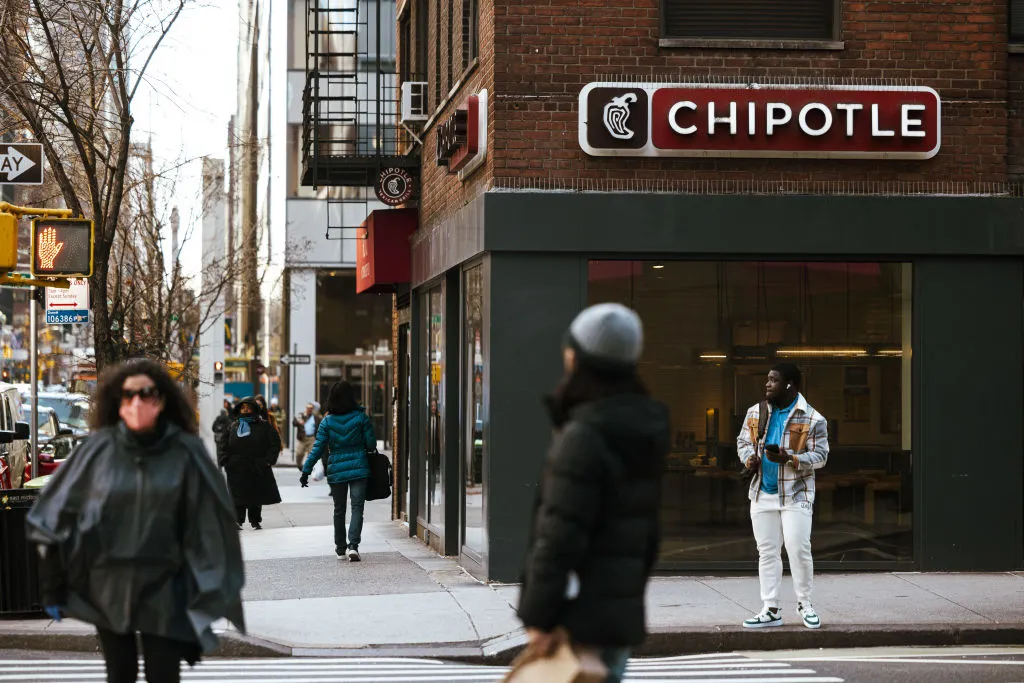
Shares in Chipotle Mexican Grill (CMG) have been a long-term market beater, but there's a twist. The fast-casual food chain is a great example of what happens when a company's days of hyperfast growth have long passed.
Like McDonald's (MCD), CMG claims humble origins, starting with a single location. The first Chipotle opened in Denver in 1993 and it quickly became a hit. Founder Steve Ellis's focus on high-quality and fresh ingredients served in a fast-food format was revolutionary at the time.
The fast-casual restaurant concept was born.
From just $107.88 $24.99 for Kiplinger Personal Finance
Become a smarter, better informed investor. Subscribe from just $107.88 $24.99, plus get up to 4 Special Issues

Sign up for Kiplinger’s Free Newsletters
Profit and prosper with the best of expert advice on investing, taxes, retirement, personal finance and more - straight to your e-mail.
Profit and prosper with the best of expert advice - straight to your e-mail.
Within five years, the chain operated 16 locations spread around Colorado. McDonald's – game knows game – was a minority investor. MCD's injection of capital allowed Chipotle to expand rapidly, further whetting the burger chain's appetite. Pretty soon, MCD became CMG's majority owner. By 2005, Chipotle was a national phenomenon with 500 restaurants across 25 states.
At this point, it was time for McDonald's to cash out. The CMG investment, while lucrative, was a distraction from the company's core fast-food business model. And so McDonald's spun off Chipotle Mexican Grill in an initial public offering for the ages. CMG went public in January 2006 at a price of $22 a share. It closed at $44, or a 100% gain in its first trading session.
Traders and investors would continue to enjoy outsized gains for years as the company's expansion and national impact only seemed to accelerate. Even the Great Recession couldn't slow the chain down. Indeed, the value proposition of fast-casual dining attracted cash-strapped customers away from pricier sit-down restaurants.
By 2015, Chipotle had more than 2,000 locations across 48 states. The stock was up 1,500% from the IPO closing price. And then a near-disaster struck. Shares lost almost half their value over the next two years amid multiple outbreaks of food-borne illnesses. It turned out that fresh ingredients also carried the risk of making customers violently ill from E. coli and Norovirus.
The consumer discretionary stock eventually rebounded and went on another spectacular run, but more recent returns have been disappointing. Investors were no longer willing to pay a hefty premium when growth began to slow. A stock that once traded as high as 50 to 80 times earnings estimates saw its multiple collapse by half. CMG found itself branded by some as a fading giant.
The bottom line on CMG stock?
Have a look at the below chart and you'll see that truly long-term investors in CMG are sitting on market-beating returns. As for shorter time frames, however, the results are not good.
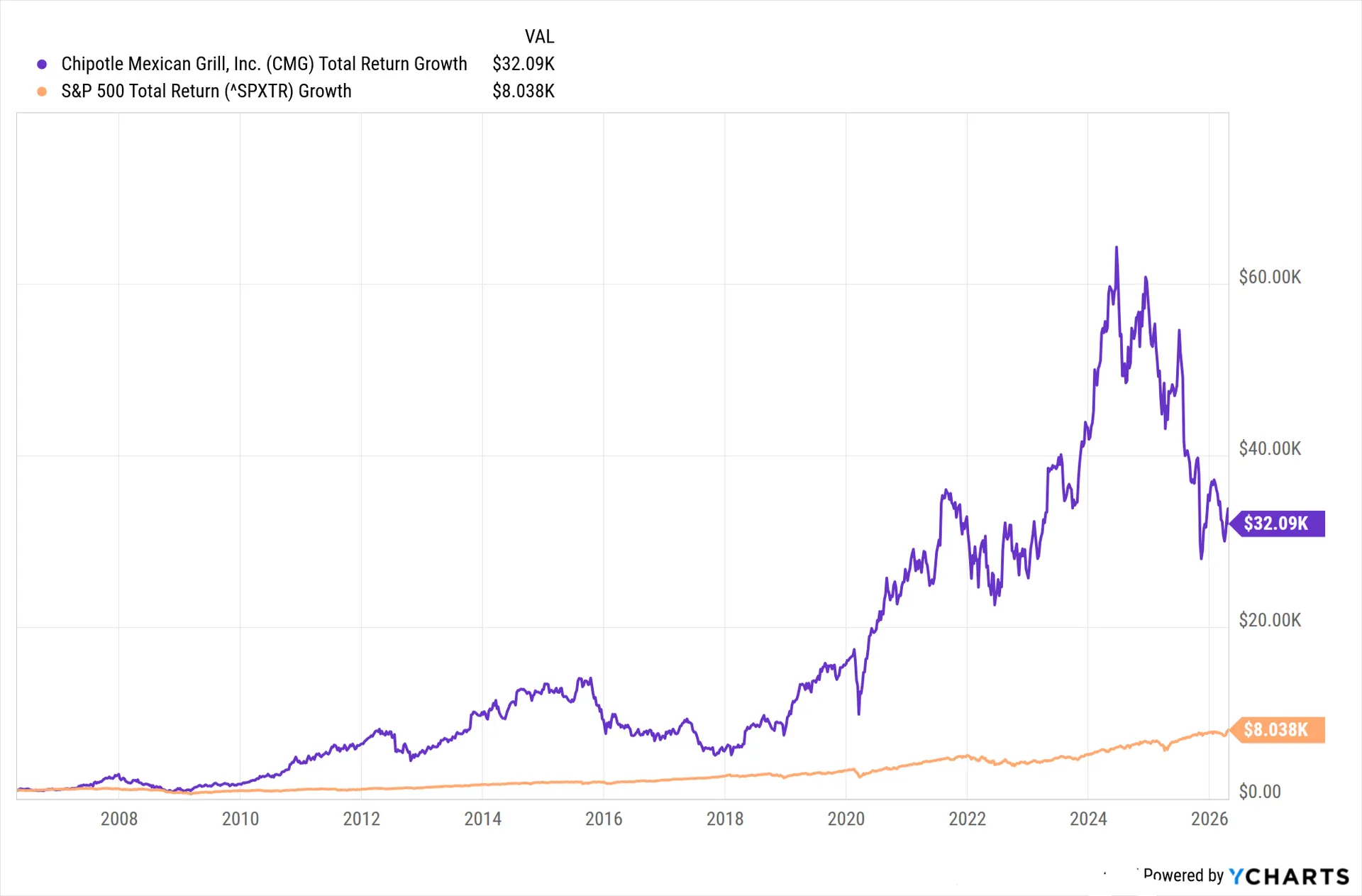
True, for its entire life as a publicly traded company, CMG, which doesn't pay a dividend, generated an annualized total return of 19.8%. That beats the S&P 500's annualized total return (price change plus dividends) by 9 percentage points. That's a big deal.
Unfortunately, other time frames are not nearly so remunerative.
The large-cap stock lags the S&P 500 over the past one-, three-, five-, 10- and 15-year periods. Indeed, over the past 52 weeks, CMG lost more than 30% vs a gain of more than 30% for the broader market.
The past two decades have been much more kind. If you put $1,000 into CMG stock 20 years ago, it would be worth about $32,000 today. That's good for an annualized total return of 18.9%.
The same sum socked away into an S&P 500 index fund over the past two decades would be worth almost $8,000 today, or 11% annualized.
CMG stock has been a terrific buy-and-hold bet, but it appears to be heading in the wrong direction. Its days of hyperfast growth are behind it.
As for where CMG stock goes from here over the next 12 months or so, Wall Street is bullish on the name. Of the 38 analysts covering the stock surveyed by S&P Global Market Intelligence, 22 call it a Strong Buy, four say Buy and 12 have it at Hold. That works out to a consensus recommendation of Buy with high conviction.
More Stocks of the Past 20 Years
- If You'd Put $1,000 Into Intel Stock 20 Years Ago, Here's What You'd Have Today
- If You'd Put $1,000 Into Apple Stock 20 Years Ago, Here's What You'd Have Today
- If You'd Put $1,000 Into Adobe Stock 20 Years Ago, Here's What You'd Have Today